



Four designers. Four distinct points of view. All in their mid-thirties. One unmistakable shift in the way eyewear is designed, presented and understood.
Eyewear is becoming more than eyewear.
The change is subtle enough to escape the usual metrics. You may not see it in quarterly sales reports, trade-show booths or account numbers. Look closer, though, and the signs are everywhere: in the cases, the campaigns, the typography and the increasingly selective way stores curate their boards. Most of all, you can hear it in the way certain brands have begun to speak.
We may be witnessing the beginning of a genuine shift.
Craftsmanship is no longer enough
For a long time, eyewear became very good at making eyewear.
Beautiful acetate. Japanese titanium. Hand-finishing. Heritage factories. The industry learned the vocabulary and repeated it until craftsmanship itself became marketing.
But exceptional construction is no longer enough to build an exceptional brand. The most interesting names in eyewear already understand this. They are developing a design language that extends far beyond the frame.
The case matters. The packaging matters. The photography, the typography and the person wearing the frame all matter. Even the words a brand uses to describe itself matter.
These things may sound superficial, but together they represent something much deeper: world-building.
The strongest brands are no longer asking only, “How do we make a better frame?” They are asking, “What does our world look like?”
So, who is building it?

Kevin Godart Elbaz – SATO : two perspectives, one creative tension.
SATO is one of the most compelling examples, not simply because of the frames, but because of the collision behind them.
Kevin Godart-Elbaz and Jérémie Gamon bring two backgrounds and two distinct ways of seeing. Kevin’s visual instinct extends far beyond eyewear. His photography reveals a fascination with architecture, fashion, people, texture and the strange details most of us would walk straight past.
Photography tells us something intimate about a creative person: what they choose to notice. And what we notice eventually becomes part of what we create.

SATO does not feel like one viewpoint swallowing the other. It feels like tension: precision and instinct, Japan and the West, past and future, structure and attitude.
Two creative languages meet inside the same object. Eque M oversees production in Japan, while at influential retailers such as Puyi, which help shape trends across the Asian market, SATO frames are marketed under the name SATO & Eque M.
Perhaps that is exactly what this new era needs, not another brand trying to manufacture a personality, but designers who already have one.
A silhouette can be copied. A factory can be found. Acetate can be sourced. Campaigns can be studied and language can be imitated. But one thing remains extraordinarily difficult to reproduce: the way someone sees.

Julien Couture – Lunetterie Générale: no detail is secondary.
Spend enough time inside the world of Lunetterie Générale and eventually you stop looking only at frames.
You begin to see cinema, Art Deco, Tokyo, Monaco, aviation and nostalgia. Julien Couture takes references that could easily feel disconnected and draws them into one coherent universe.
The campaigns do not feel like product photography. They feel like scenes. There is atmosphere, casting, location, styling and typography. The eyewear belongs inside the story; it is not the entire story.
That distinction matters. Plenty of brands can produce a beautiful campaign. Building a visual language that people recognise before they see the logo is something else entirely.
Then there is the case.

Julien spent roughly 16 months developing it, not a frame, but a case. Anodised aluminium, leather, construction and proportion: 16 months spent refining something many brands would treat as packaging.
At first, that may sound excessive. Within Julien’s world, it makes perfect sense. If every detail contributes to the story, there are no secondary details.
That is the difference between branding and world-building. Branding tells us who you are. World-building makes us feel it.

Andra Simina – The Other Glasses: let the engineering catch up.
Then there’s Andra. Different energy entirely. The Other Glasses feels sharper. Architectural. Technical. Almost industrial.
It transforms functional eyewear into collectible design, uniting fashion with everyday performance. The Other Glasses is a creative studio that brings together art, technology and engineering to push the boundaries of eyewear design.
There is beauty in it, but the beauty feels engineered rather than decorated. And that’s where Andra becomes particularly interesting.
She doesn’t seem interested in choosing between design and function. She wants both.
When titanium presented a challenge to the construction her designs required, the obvious solution would have been to change the design, simplify production, protect the margin and move on.
She went in the opposite direction.

Andra searched for the right soldering and construction solution so the original design could survive, even if doing it properly cost more. That may sound like a minor production story. It is not. It is a philosophy.
Everyone likes to talk about uncompromising design, until the compromise becomes convenient. Until production becomes complicated, margins tighten and someone puts a cheaper option on the table.
Andra chose the idea. And once we understand that, we start seeing the same mentality everywhere. The custom components. The mechanisms. The geometry. The relationship between titanium and acetate.
And especially the imagery.
In The Other Glasses campaigns, frames are not treated like merchandise. They are treated almost like sculpture. Faces become landscapes, light becomes material and negative space becomes part of the composition.
Product, photography and engineering all speak the same language. It never relies on elaborate sets or props to manufacture status.
Nothing feels added afterward.
That is identity.

Carlo SESTINI: Quiet luxury in its purest form.
With Sestini, the founder and the brand feel almost impossible to separate.
Look at Carlo’s public persona, his personal style, wardrobe and carefully composed visual world and the connection becomes apparent. The brand does not feel constructed around a target demographic. It feels like an extension of its founder’s eye.
Carlo translates his own world into Sestini.
This becomes particularly clear through the packaging. The box is not treated as something that merely protects the frame. It creates a ritual around discovering it. Materials, colours, proportions and presentation are considered with the same precision as the eyewear itself, resulting in one of the more elaborate experiences found within independent eyewear.
The attention to detail never feels accidental.

The frames themselves remain restrained: classical silhouettes, clean lines and subtle references to another era. They evoke aristocratic leisure and the elegance of objects designed to endure, without becoming costumes from the past.
Sestini feels like spending summer on the Amalfi Coast and winter in St. Moritz. Two destinations, two seasons, but the same cultivated sensibility. It is less nostalgia than a form of time travel, filtered through a contemporary Italian perspective.
That is what makes the brand quiet luxury in its purest form. It does not need to manufacture status through spectacle. Its value is communicated through materials, craftsmanship, proportion and the consistency of the world surrounding the product.
The logo does not create the world. The world gives meaning to the logo.
That is not simply branding. It is authorship.
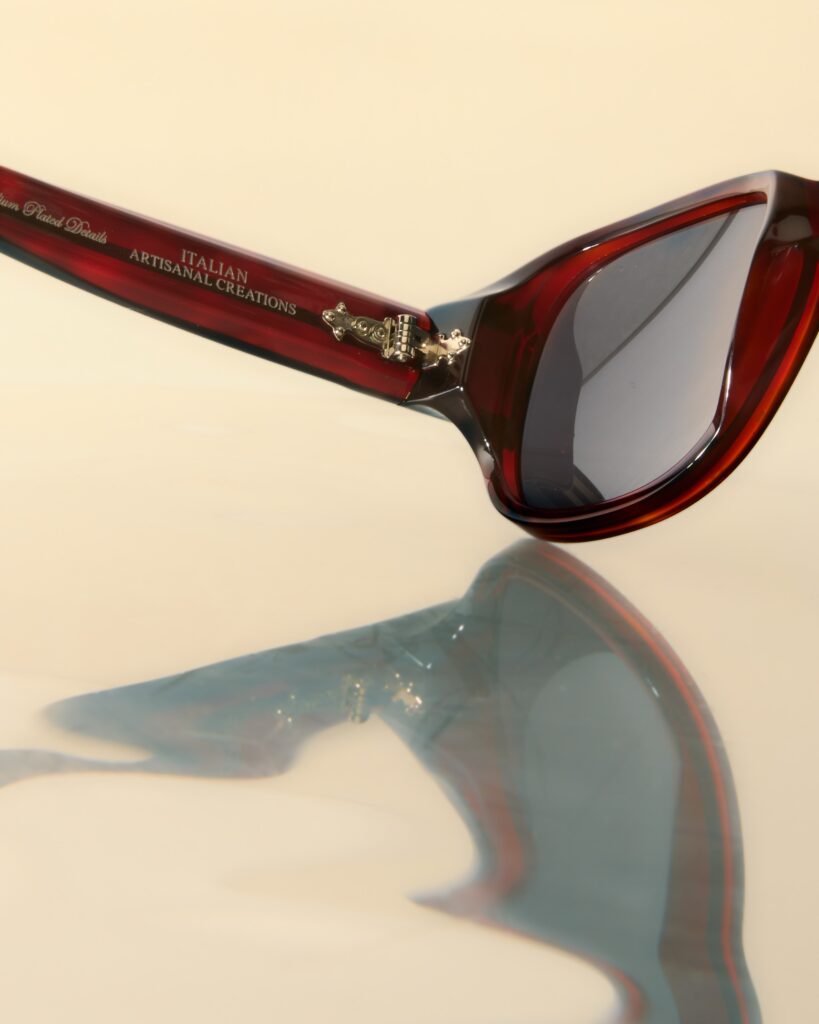
Different aesthetics, shared conviction
Kevin Godart-Elbaz. Julien Couture. Andra Simina, Carlo Sestini, four designers. Four personalities. Almost no common aesthetic. Perfect.
Because this movement is not another trend. It is not thick acetate, titanium or whichever colour suddenly appears on every board next season. It is something far more difficult to manufacture: a point of view.
Kevin’s eye. Julien’s cinematic obsession. Andra’s refusal to let engineering dictate the limits of her imagination. Carlo’s instinct for turning personal taste into an entire world.
Their products do not need to look alike. Their conviction does.
And that conviction is creating momentum.
One brand changes how eyewear is photographed. Then another follows, and another. Someone turns the case into part of the identity, and suddenly everyone remembers that packaging exists. A particular typography appears, followed by a particular attitude and a particular way of talking about product.
Give it a season. The references travel.
There is nothing wrong with influence. Influence is how culture moves: someone introduces a language, someone else interprets it, and another person pushes it somewhere new. Eventually, however, someone simply repeats the sentence and signs their name at the bottom.
That is the difference.
We have reached a point at which making a beautiful frame is no longer enough. The materials are extraordinary. The factories are extraordinary. The craftsmanship is extraordinary. But excellence has become the entry fee.
Perspective is the differentiator. Taste. Conviction. Personality. The ability to use the same materials available to everyone else and create something that feels as though it could only have come from you.
Perhaps that is the real shift. The question is no longer, “What is the market looking for?” It is, “What do we want to put into the market?”
One question follows culture. The other has a chance to create it.
Watch the details and who gets copied next
The eyewear industry is not changing overnight. Its attitude is changing, though. Its language is changing. Its understanding of what a brand can be is changing. And somewhere beneath it all, something that has been missing for a while is returning: passion.
Not passion as a marketing word, but passion as competition, pride, experimentation and obsession. The desire to make something that actually matters.
Maybe we are not witnessing the new era yet. Maybe we are witnessing the tension immediately before it.
If we want to know where eyewear is going next, perhaps we should stop looking at who is making the most noise and start looking at who everyone else is beginning to sound like.
Edited by Maya M.

 English
  French
  Italian
  Spanish
  Portuguese
  German
  Korean
  Japanese