


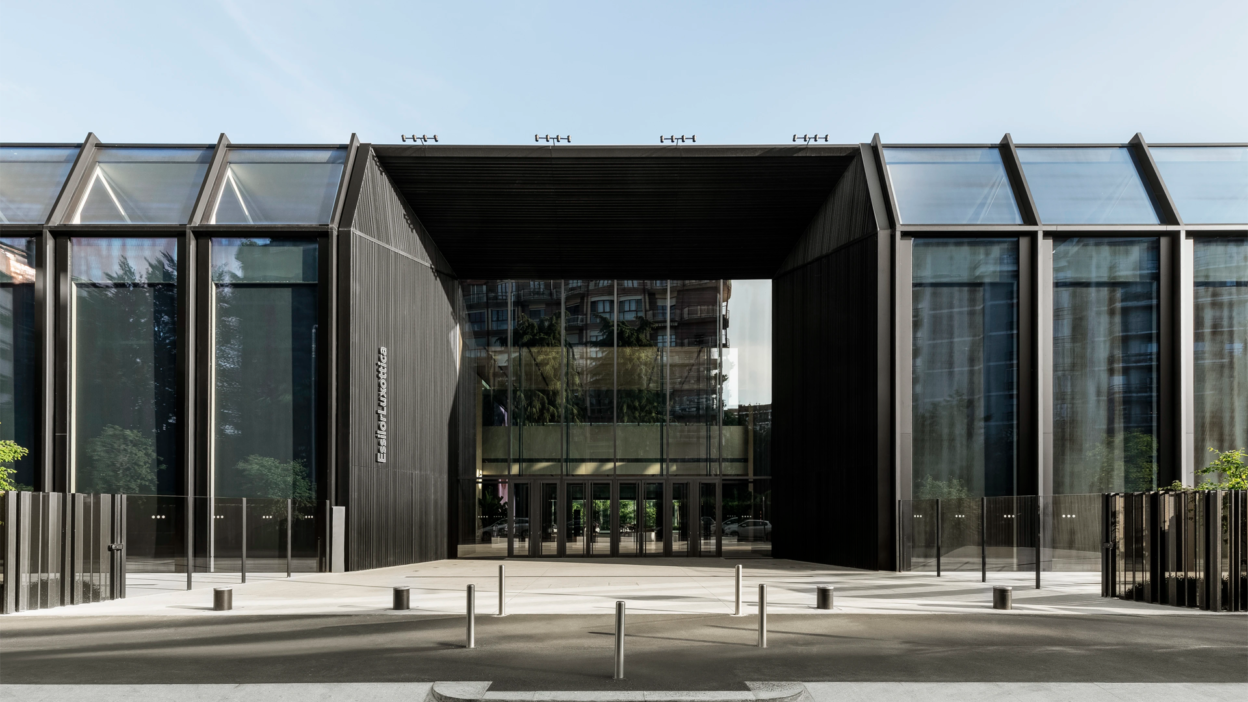
Investors are debating technology and governance. A quieter change in how luxury eyewear earns cultural relevance may prove just as important.
EssilorLuxottica’s share price has fallen by roughly half from its record closing high of €320.70 in November 2025. The convenient explanation is that investors became carried away by smart-glasses enthusiasm, and then reconsidered the category’s competitive and technological risks.

Although EssilorLuxottica reported 9.7 percent revenue growth and a 15 percent increase in adjusted operating profit in the first half of 2026, market expectations had been considerably higher. The results do not indicate an operational collapse, but they have prompted a sharp reassessment of the company’s future growth.
The technology concerns are nevertheless real. Apple, Google, Samsung, Sesame and other technology groups could turn smart eyewear into a platform contest rather than a conventional accessories category. Battery life, design, privacy, social acceptance and prescription integration also make adoption less predictable than the early excitement suggested.

Reported governance tensions have added another layer of uncertainty. Leonardo Maria Del Vecchio, the founder’s 31-year-old son, left his positions as chief strategy officer and Ray-Ban chairman at the end of August. His departure followed reported disagreements, although that alone cannot explain the scale of the market correction.
A less discussed question sits inside the traditional eyewear business: is the meaning of luxury changing?
At the top end of the market, a visible logo is no longer the only, or necessarily the strongest, expression of status. Independent optical boutiques increasingly encounter clients interested in distinctive design, material quality, limited production and manufacturing provenance. Broader luxury research supports the direction of travel: EY found that 62 percent of surveyed clients ranked material quality among the leading influences on their most recent luxury purchase.
Popular culture offers signals rather than proof. A series such as Netflix’s The Gentlemen has mixed global fashion labels with specialist eyewear names including Dita, Ahlem and SATO. The frame is increasingly being treated as an authored design object, not merely an extension of a fashion-house logo.
Independent brands remain fragmented and cannot match EssilorLuxottica’s distribution, lens technology or retail infrastructure. But they do not need to match its scale to compete for taste leadership.

At the same time, debate across the eyewear industry is increasingly focused on what a more aggressive entry by Apple, Google, Samsung and other technology companies could mean for the middle and lower ends of the market. One emerging scenario suggests that connected eyewear could put significant pressure on these segments, loosely echoing the disruption smartwatches brought to parts of the traditional watch industry. The result could be a more polarised market: technology-led products competing for the mass consumer, while the strongest high-end houses preserve their relevance through design, craftsmanship, scarcity and cultural value. This outcome is far from certain, given the remaining constraints around price, battery life, regulation and consumer acceptance. If it materialises, however, it may create not simply a new product category, but an entirely new industry structure.
Leonardo Maria Del Vecchio’s age does not establish superior judgement. Yet his departure is symbolically notable: one of the group’s youngest senior voices, and one potentially closest to the emerging luxury consumer, is no longer in an executive role.

The overlooked risk is not simply that smart glasses might disappoint. It is that conventional glasses may quietly be becoming a different kind of luxury business, one in which scale remains powerful, but cultural relevance can no longer be taken for granted.
A few years ago, brands such as Ray-Ban, Persol and Oliver Peoples served as default aspirational choices for many premium-eyewear consumers. Today, a visible segment of that audience appears increasingly drawn to specialist names such as Jacques Marie Mage, whose limited production, distinctive design language and association with prominent cultural figures have helped turn its frames into recognisable status markers. The brand’s rise should not be described as the sole cause of a market-wide transformation, but it has arguably introduced more consumers to the broader independent-eyewear category, where they often go on to discover other design-led labels. Although comprehensive market-share data remain limited, the evolution is increasingly visible in the assortments of high-end optical retailers, many of which now place independent brands at the centre of their portfolios rather than treating them as niche additions.
Could the market itself be changing, with consumers aged 20 to 35, after years defined by logomania, increasingly seeking limited editions, craftsmanship and compelling brand narratives instead? It is a question the eyewear industry is beginning to ask with growing urgency.
Our analysis therefore points to two related hypotheses. First, smart glasses are likely to become an increasingly crowded category as major technology companies enter alongside Meta. Second, if connected eyewear gains broader consumer acceptance, part of that growth could come at the expense of conventional products in the mid- and lower-priced segments, potentially including brands within EssilorLuxottica’s own portfolio. This should be understood as a possible market scenario rather than a demonstrated outcome: the extent of any cannibalisation will depend on pricing, adoption rates, product positioning and whether consumers treat smart glasses as substitutes for, or complements to, traditional eyewear.
Photo Cover Source: MolteniGroup / Essilor Luxottica HQ, Milan
 English
  French
  Italian
  Spanish
  Portuguese
  German
  Korean
  Japanese