


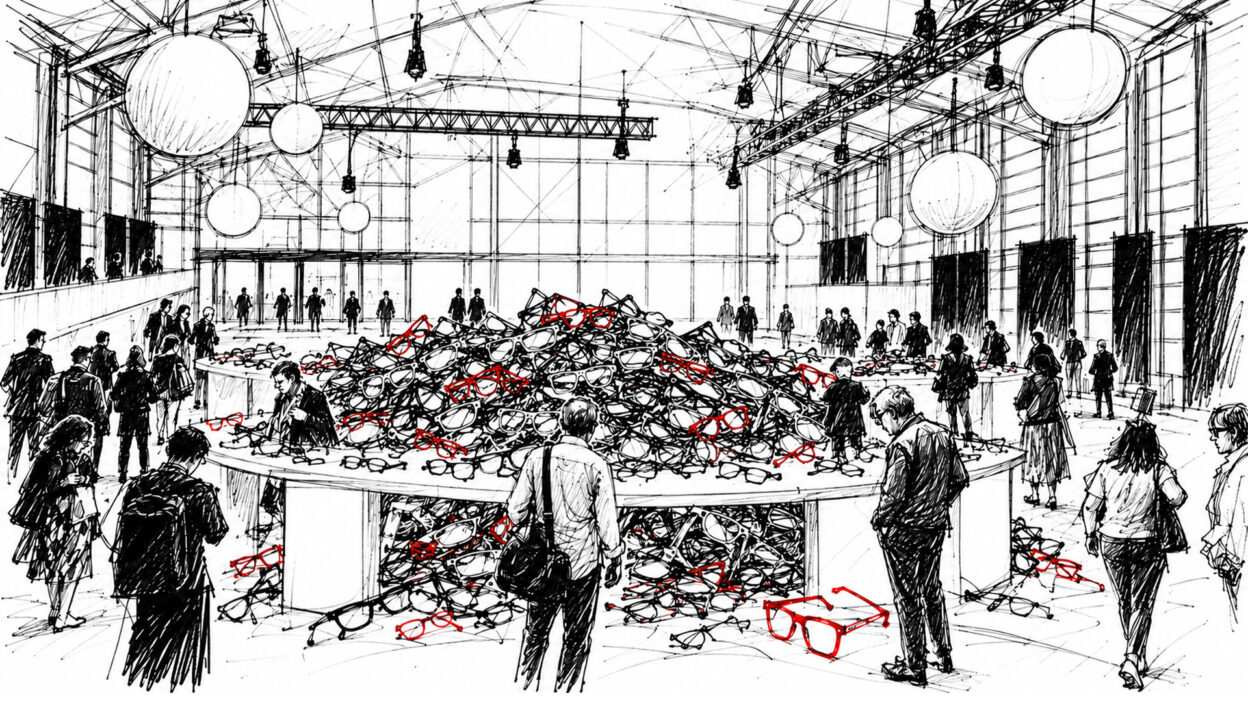
Behind the luxury image lies a market driven by fear, commercial pressure, declining sales and mountains of unsold stock.
After a week in Paris, one conclusion felt unavoidable: the optical industry is becoming nervous. And yet, one detail from these days in Paris should not go unmentioned: everyone was talking about Curated Optics.
For the European market, this week in Paris was not about selling eyewear. It was about agents building their personal image on the credibility of established brands, then using that borrowed authority to sell weaker labels. Opticians adding just 10 or 12 frames to existing portfolios and attending merely to maintain visibility and avoid feeling excluded; and retailers unable to open new accounts because they remain burdened by years of dead stock pushed on them by agents.
It was also about brands presenting frames from previous seasons as new collections.
Fewer buyers appear to be attending trade shows. Several luxury players have already confirmed that they are abandoning the traditional exhibition format, choosing instead to present their collections at private showrooms and events across the city. Inside the fairs, the atmosphere is increasingly defined not by discovery, but by desperation, the visible anxiety of an industry trying to justify its costs and protect a system that may no longer serve its participants.
The question is no longer simply whether trade shows remain relevant. The more uncomfortable question is whether the entire distribution model of independent eyewear is approaching a breaking point.
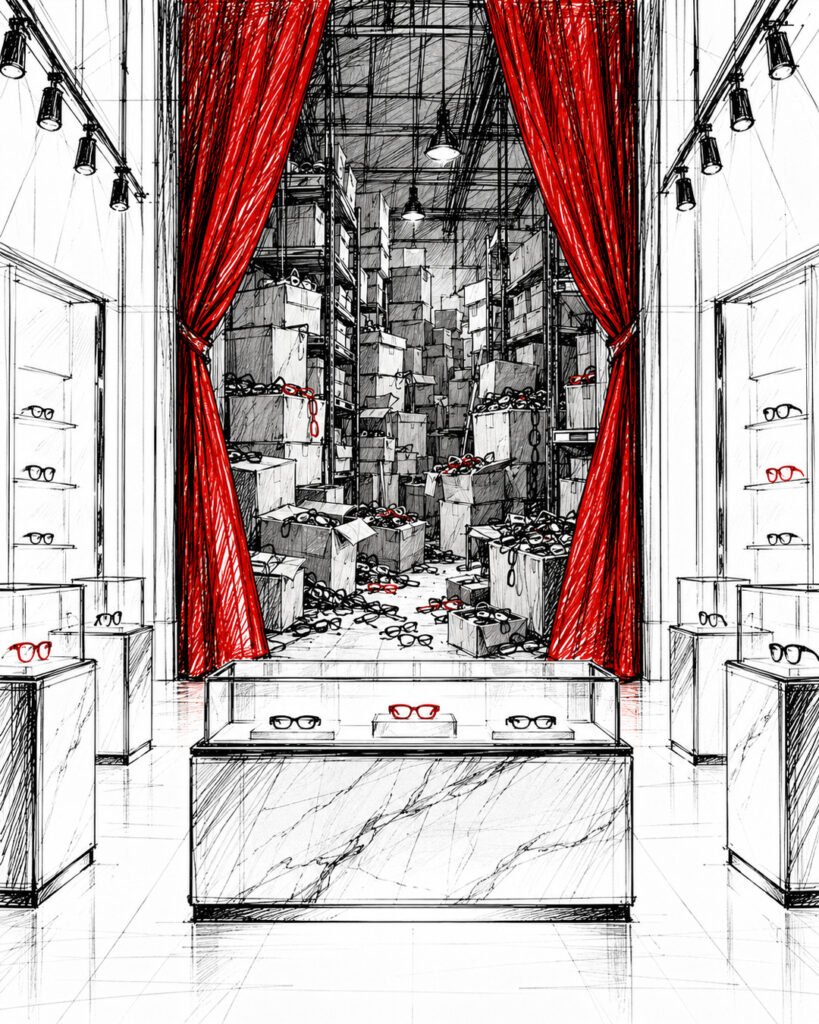
When Representation Becomes Control
Agents were once expected to connect brands with the right optical stores, develop territories and cultivate long-term relationships. Today, some appear to have assumed a different role: controlling access, monitoring orders and discouraging retailers from looking beyond their portfolios.
During the Paris fairs, I watched agents escort important buyers from booth to booth, remaining close as orders were discussed. In some cases, they appeared less interested in facilitating introductions than in keeping track of which brands were selling, how much they were selling and to whom.
I also saw agents positioning themselves next to brand owners for long periods, seemingly monitoring every commercial conversation. Retailers were asked what else they had purchased, from which brands and in what quantities. That information can then be used to undermine competitors, influence future buying decisions or dismiss another collection before the optician has had the opportunity to evaluate it independently.
In an industry without consistent standards for assessing the value, construction and originality of a frame, reputation can be manipulated remarkably easily.
The result is a form of commercial pressure that many opticians privately describe as coercive. Retailers who want to purchase brands outside an agent’s portfolio may find themselves discouraged, questioned or warned against doing so. Meanwhile, brands that refuse representation can risk losing access to stores influenced by the same agents. The messages we have received from opticians in recent days about commercial blackmail have made us realise that the industry, in its current form, can no longer continue.
Are leading brands aware that their commercial power may be used in this way? Are they prepared to distance themselves from agents who pressure retailers and undermine fair competition or have they themselves encouraged the discrediting of competing brands?
The Copy-Paste Portfolio
Walk into enough independent optical stores and a pattern emerges.
For years, agents have encouraged stores to buy the same supposedly essential brands. The result is a copy-paste retail landscape in which independent opticians increasingly carry overlapping products, tell similar stories and compete for the same customers.
This raises another difficult question: are declining retail sales partly the consequence of portfolios assembled by agents rather than curated by opticians?
When every store sells the same brands, independence becomes largely cosmetic. Differentiation disappears, inventory accumulates and price competition intensifies. The optician carries the financial risk, while the rest of the distribution chain has already recorded the order as a success.
That success may be temporary. Artificially elevating a small group of brands can create rapid growth, but it can also produce saturation. Once too many stores carry the same labels and once consumers lose interest the decline can be just as dramatic as the rise.
Some brands have invested heavily in image, visibility and carefully manufactured desirability. But marketing cannot indefinitely compensate for weak sell-through, repetitive design or declining product quality.
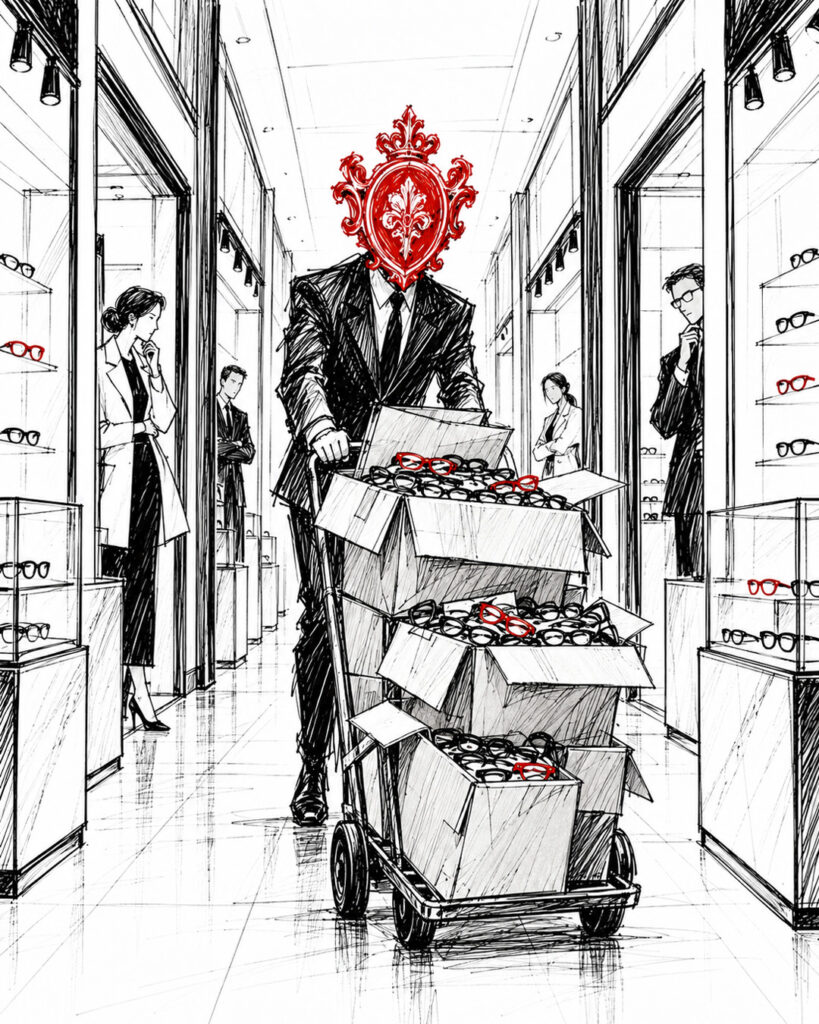
The Inventory Nobody Wants to Discuss
Sales figures may vary between markets, but the message from many independent opticians is strikingly consistent: this has been one of their weakest years.
Behind the polished booth interiors sits a less glamorous reality. Many respected brands are still holding inventory from previous seasons. For years, brands and agents pushed increasing volumes of frames into the market, including products that did not always justify their positioning or price.
Some store owners have sold their businesses. Others are struggling to remain profitable. Many still travel to international fairs, but instead of placing substantial orders, they purchase only few frames enough to maintain a relationship or test a collection without assuming another major inventory risk.
The frantic activity at trade shows can therefore be misleading. People move rapidly between booths, meetings and events, trying to recover the cost of exhibiting at shows such as SILMO. Beneath the energy lies a growing doubt: is participation still worth it?
The numbers, ultimately, are harder to manipulate than the atmosphere.
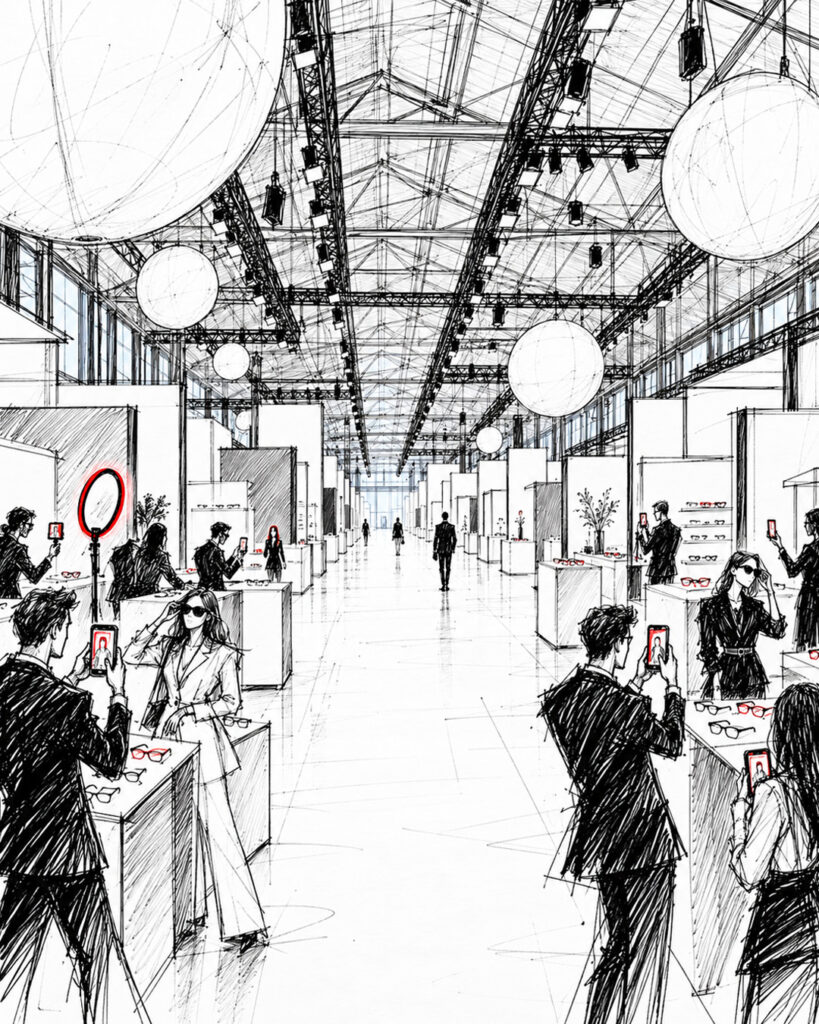
When Agents Become Vlogers
One of the industry’s more revealing developments is the transformation of agents into vloggers and social-media personalities. Commercial representation is increasingly mixed with personal branding, visibility and ego. They attended events hosted by celebrated brands, yet their social-media stories focused primarily on promoting themselves rather than the brands. Access to prestigious labels had become a tool for pushing weaker brands into their territories while strengthening their own personal reputations.
Curated Optics has become a convenient scapegoat, an invisible force supposedly driving industry figures to broadcast their entire lives in a desperate attempt to remain relevant. Yet Curated Optics is not the problem simply because it reports what is happening. The real problem is that the market has reached saturation point.
We watched two well-known Scandinavian optical stores, both connected to the same agent and already carrying the brand, publish a relentless stream of promotional stories over several days. The objective seemed clear: to create momentum, manufacture social proof and persuade other retailers that the collection was selling. Yet the desperation and frustration behind the campaign were impossible to miss.
It is less comfortable discussing sell-through, unsold stock and the profitability of its retail partners.
The View From Asia and the Middle East
The outlook is not equally bleak everywhere.
Markets including Japan, South Korea, India and several Middle Eastern countries continue to place significant orders and display stronger financial confidence. One possible explanation is that buying decisions in these regions have not been shaped to the same extent by entrenched agency networks.
Retailers can act more independently. Decisions are clearer, faster and more closely connected to local customers. Buyers select products because they believe in them, not because they fear losing access to another brand or damaging a relationship with a powerful representative.
This does not mean that these markets are immune to speculation or over-distribution. It does suggest, however, that independence of judgment remains one of the most valuable assets in eyewear retail.
A Market Correction Is Coming
The optical industry may not be heading for bankruptcy in the literal sense. But parts of its current system are undoubtedly facing a reckoning.
Trade shows must prove that they offer more than expensive visibility. Brands must stop treating wholesale orders as the final measure of success. Agents must decide whether they exist to build healthy markets or to control them. And opticians must reclaim the authority to curate their own stores.
The next generation of successful eyewear businesses will not be built through intimidation, manufactured hype or identical portfolios. It will be built through better products, transparent relationships, disciplined distribution and genuine retail demand.
The industry does not need more noise. It needs honesty, especially about who is selling, who is merely buying and who is left holding the stock when the spectacle is over.
Another problem is demographic: an estimated 70 percent of those attending appeared to be over the age of 55, while young designers were marginalised and exploited. At times, there seemed to be more agents than genuine visitors.
What Is the Solution for Brands and Opticians?
For opticians, the answer begins with stepping away from the habits of the current industry: unjustified expenses, excessive commissions and commercial pressure from agents who treat access to desirable brands as leverage. Seek out brands that work with you, offer favourable payment terms, recognise you as a partner rather than merely a customer, and remain invested in your long-term success.
For brands, the solution is to build where others have not. The established formula is no longer reliable. Develop direct relationships with retailers and create your own events instead of continuing to finance a system that consumes resources without guaranteeing meaningful customers or sustainable sales.
Most importantly, a brand must own its retail network and customer relationships not surrender them to its agents.
Many brands are afraid to leave their representatives because their portfolios are not truly theirs. Retail access often depends on personal friendships, influence and, in some cases, manipulation between agents and opticians. Brands understand that once the agent disappears, those relationships—and the sales attached to them may disappear as well. That dependency is precisely what must change.
Conclusion
It is clear that decisions made under the influence of agents in previous years have eroded opticians’ confidence, as declining financial results and mounting dead stock expose the consequences. Brands are now questioning whether the current distribution model still works, while anxiety and nervousness have become palpable across the entire industry.

 English
  French
  Italian
  Spanish
  Portuguese
  German
  Korean
  Japanese