



They promise independent opticians lower prices and offer brands access to hundreds of potential accounts. But when access does not produce sales and collective purchasing destroys differentiation, who is the arrangement really designed to serve?
Independence may be the most overused word in the optical industry.
Independent opticians pride themselves on offering an alternative to corporate chains: more considered service, better product knowledge and a carefully edited selection of eyewear. Emerging luxury brands make a similar promise. They offer originality, scarcity and a point of view that cannot be replicated by the mass market.
Yet both increasingly participate in a system that risks undermining the very independence they claim to protect: the optical buying group.
The proposition appears compelling. Retailers pay to join a collective that negotiates preferential prices, provides marketing materials and simplifies back-office administration. Brands become approved suppliers in the hope of gaining access to the group’s network of stores.
Opticians expect lower costs. Brands expect higher sales.
Both may be confusing access with value.
Too often, buying groups become a route to market for dead stock, factory seconds, and obsolete inventory. Retailers ultimately find themselves selling outdated collections that brands are simply trying to clear from their warehouses.

The Double Promise
Buying groups sell two different versions of the same dream.
To the optician, they sell purchasing power. A single independent store may have limited leverage with laboratories, lens manufacturers, frame suppliers and service providers. Combine hundreds or thousands of practices, however, and the group can supposedly negotiate conditions no individual retailer could obtain alone.
To the brand, the group sells reach: a ready-made network of optical accounts, presented as a faster route to distribution.
But a persuasive benefits list is not the same as measurable economic value.
The question is not whether a buying group provides discounts, content or administrative support. The question is whether those benefits create more value than the fees, concessions, limitations and strategic dependency required to obtain them.
A Discount Is Not Automatically a Saving
The optical industry has become remarkably skilled at presenting discounts as profit.
They are not the same thing.
A retailer receiving a five-percent discount has not necessarily improved its financial position. The calculation must include membership fees, management charges, minimum purchasing expectations, the cost of unwanted inventory and whether comparable terms could have been negotiated directly.
One UK organisation, for example, publicly states that it charges no joining or subscription fee but applies a five-percent management fee to purchases from certain suppliers. Other groups use monthly memberships, supplier-funded programmes, rebates or combinations of these structures. The models vary, making direct comparison essential.
A discount on a product the retailer would not otherwise have selected is not a saving. It is an incentive to spend.
Nor is a retrospective rebate automatically evidence of better buying. It may simply reward a practice for concentrating more of its purchasing among preferred suppliers. That can improve short-term costs while quietly reducing product choice.
The relevant figure is not the percentage printed on a supplier agreement. It is the retailer’s total net benefit after every fee, condition and behavioural incentive has been counted.

Access Is Not Distribution
For brands, the illusion can be even more expensive.
Joining a buying group may place a brand’s name in a supplier portfolio, but a portfolio is not a sales force. A logo on a vendor page is not a store placement. Access to a membership directory is not demand.
Unless the organisation actively introduces the brand, secures appointments, supports product education and creates measurable sell-through, the brand must still perform the work it was doing before joining. It must prospect individual stores, send samples, train staff, manage orders, provide after-sales service and finance its own market development.
The brand may therefore be expected to provide preferential pricing or make other commercial concessions while continuing to carry nearly all the cost and risk of selling.
No placement is guaranteed. No minimum order is guaranteed. No replenishment is guaranteed.
The buying group is monetising the possibility of a commercial relationship. The brand is still responsible for converting that possibility into revenue.
A buying group that merely provides visibility may be little more than a paid directory with a discount mechanism attached.
The metric should never be how many members belong to the network. It should be how many genuinely incremental accounts the group activates, what those accounts purchase and whether they reorder.
The Homogenisation of Independent Optics
The greater danger for opticians is not necessarily the membership fee. It is the gradual loss of identity.
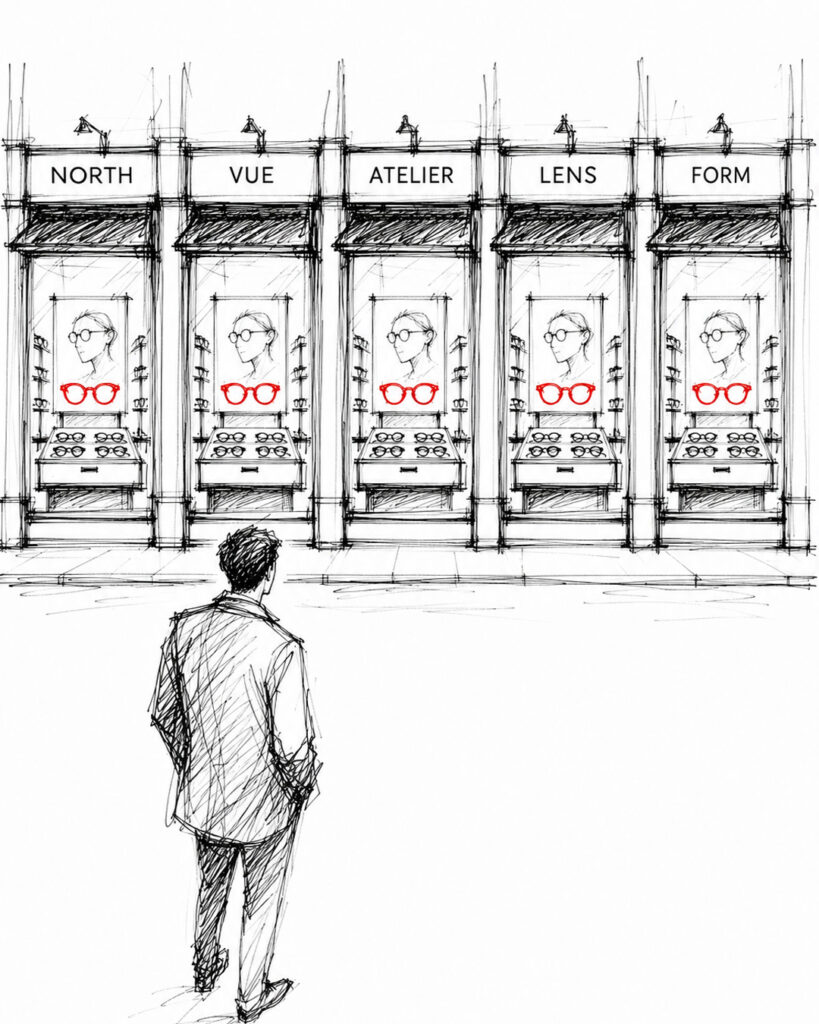
A retailer joins a buying group to compete more effectively as an independent. But if every independent member receives access to the same preferred suppliers, the same frames, the same promotions and the same marketing materials, independence becomes an ownership structure rather than a meaningful retail proposition.
The stores may remain legally independent while becoming commercially interchangeable.
This is particularly damaging in premium eyewear, where curation is not decorative. It is the foundation of the business. Customers visit a strong independent optician because they expect a distinctive selection, informed advice and products that are not available from every competitor within driving distance.
When neighbouring stores carry the same buying-group portfolio, product differentiation disappears. Competition moves towards price, convenience and promotions the exact battlefield on which independent retailers are least equipped to defeat large chains and online platforms.
The buying group may reduce the cost of individual products while simultaneously reducing the reason a customer should choose one member store over another.
That is not purchasing efficiency. It is strategic uniformity.
Why Luxury Brands Should Be Especially Cautious
For a luxury eyewear brand, distribution is not simply a method of moving units. Distribution is part of the product.
Every stockist communicates something about the brand’s position. Its location, neighbouring labels, store design, staff knowledge, pricing discipline and approach to client service all contribute to how the product is perceived.
Selective distribution allows a luxury brand to protect those signals. It can choose partners deliberately, manage geographic exposure, avoid unsuitable adjacencies and ensure that retailers understand how to present the collection.
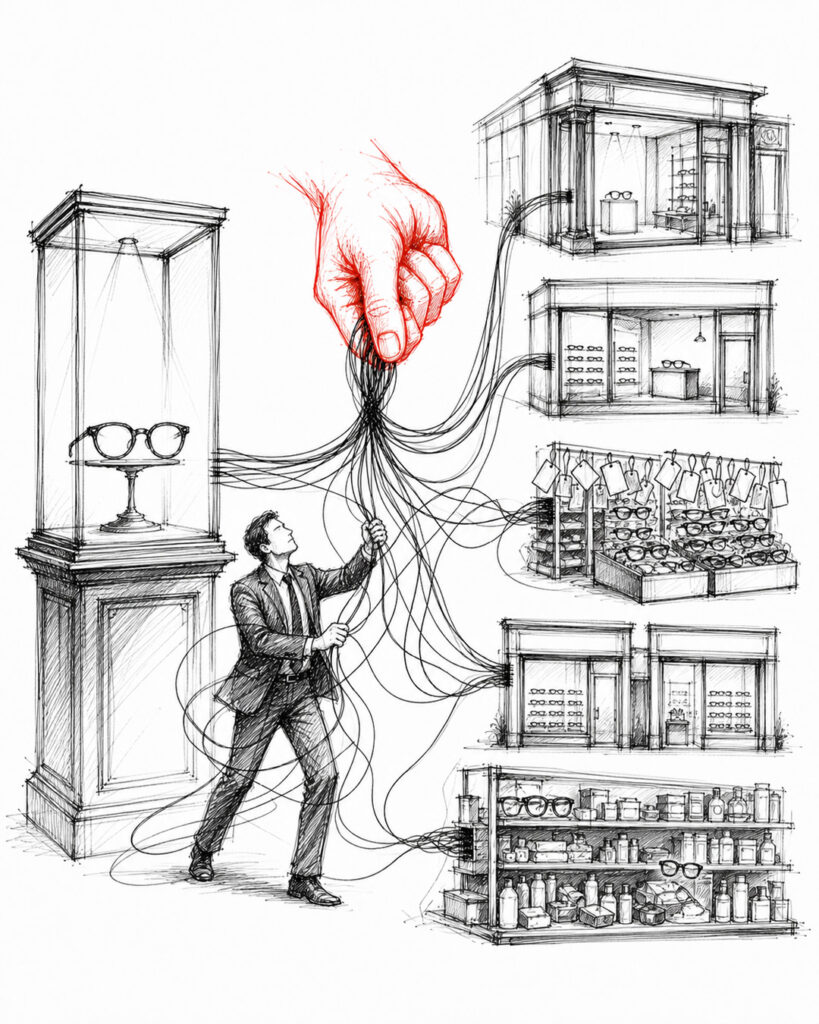
Entering a broad buying-group network can weaken that control.
If membership effectively makes the collection available to any participating account, the brand risks appearing in stores that do not match its positioning or in too many competing stores within the same market. Scarcity disappears, existing retail partners feel less protected and the brand’s carefully constructed image becomes vulnerable to discount-led purchasing.
Short-term wholesale revenue can therefore come at the expense of long-term brand equity.
For an emerging luxury label, this trade-off can be fatal. Once distribution becomes indiscriminate, exclusivity is extremely difficult to rebuild.

Who Actually Wins?
The most predictable winner is the organisation sitting in the middle.
It can receive recurring membership revenue, benefit from supplier partnerships, aggregate purchasing data and build influence without necessarily assuming responsibility for sell-through at either end of the transaction.
Large or organiser-affiliated stores may also benefit disproportionately because their purchasing volume allows them to capture more meaningful rebates and stronger commercial conditions. Smaller members may pay for access without buying enough to recover the full cost.
Suppliers gain concentrated access to potential customers, but only when the economics remain attractive after discounts, programme costs and internal sales expenses.
For everyone else, the outcome depends on information that buying groups do not always make sufficiently transparent:
- How much of the negotiated supplier benefit reaches members?
- What revenue does the group receive from vendors?
- Are all commissions, overrides and commercial relationships disclosed?
- Do affiliated stores receive different terms?
- How many supplier introductions become active accounts?
- Are claimed savings independently verified?
- Do brands retain control over which stores can purchase their products?
Without clear answers, the structure risks becoming a two-sided tollbooth: the retailer pays for the promise of savings, the supplier pays through fees or concessions for the promise of access, and the intermediary earns regardless of whether meaningful growth occurs.
Why the Model Persists
Buying groups thrive because they sell relief from two genuine anxieties.
Opticians are overwhelmed by administration, staffing, marketing, purchasing and an increasingly complex supplier landscape. The group offers simplicity and the reassuring impression that someone else has already negotiated the best deal.
Brands face a different pressure. Building a wholesale network one carefully selected account at a time is slow, expensive and uncertain. A buying group appears to offer immediate scale.
The model is powerful because it converts uncertainty into the appearance of certainty.
But convenience should not be confused with strategy. Shared marketing does not automatically create a distinctive store. A supplier list does not automatically create brand demand. A negotiated discount does not automatically create profit.
Independence Cannot Be Outsourced
For luxury eyewear brands, the priority should be controlled, intentional distribution, not the largest possible list of theoretical accounts. For premium opticians, the priority should be a portfolio competitors cannot easily replicate, not a catalogue selected by a central purchasing organisation.
The future of independent optics will not be secured by hundreds of stores buying the same products slightly more cheaply.
It will be secured by stores choosing more intelligently, brands distributing more deliberately and both sides protecting the value of being different.
Because in luxury, no discount is large enough to compensate for the loss of identity.


 English
  French
  Italian
  Spanish
  Portuguese
  German
  Korean
  Japanese