

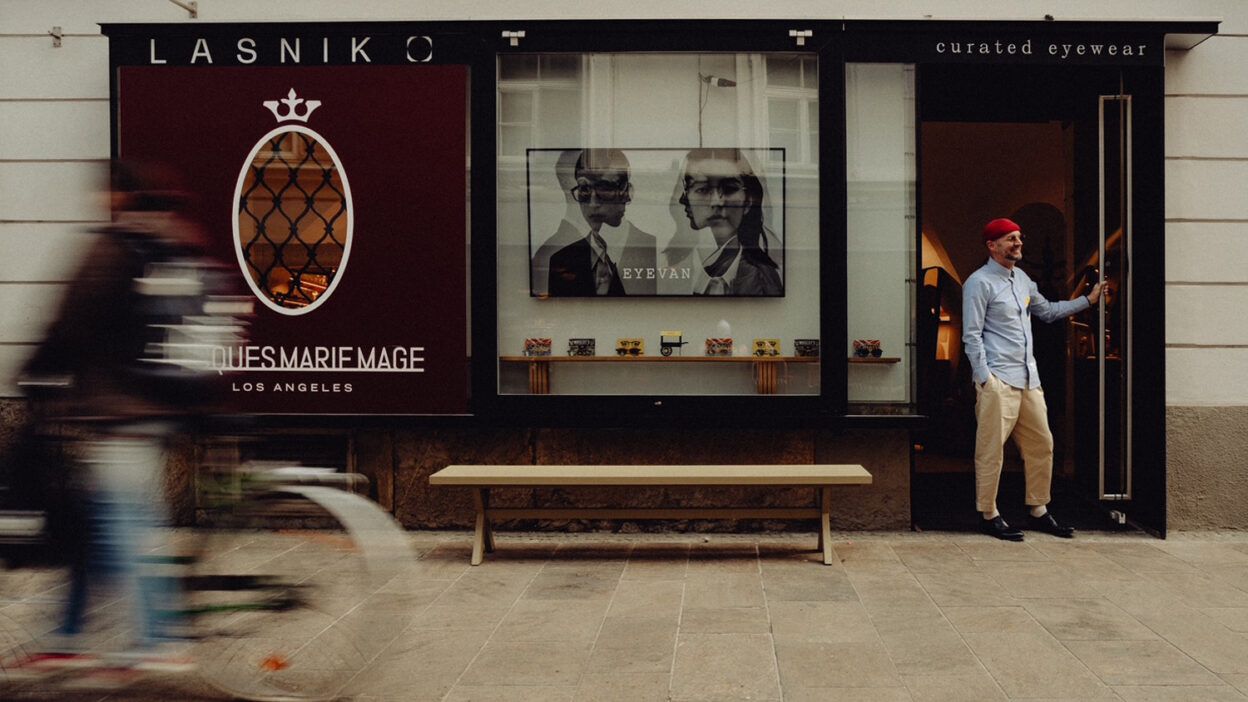
The eyewear visionary behind Lasnik on curating people as carefully as frames, turning real problems into intelligent design, and why authenticity, not hype, will define the future of independent eyewear.
In an industry where exclusivity is often reduced to scarcity, status and price, Martin Lasnik offers a more compelling definition: “Exclusivity comes from selection.”
That philosophy runs through every part of Lasnik, the family-driven optical business that evolved into a curated eyewear studio and a platform for its own product ideas. Its perspective was shaped not only by decades of fitting frames and understanding faces, but also by constant exchange with designers, makers and creative thinkers far beyond the optical world.
For Lasnik, eyewear is never just an accessory, and curation is never simply about choosing what looks good. It is about understanding who created a product, why it exists, how it performs and what it allows the wearer to express. In this exclusive interview with Curated Optics, Martin Lasnik explains how a personal need inspired one of the company’s earliest eyewear concepts. He also discusses the balance between minimalist and experimental design, the role of technology in modern optical craftsmanship, and why the rise of social media and AI may make authenticity and human connection more valuable than ever.
1. What is the story behind Lasnik, and how did the concept first take shape?
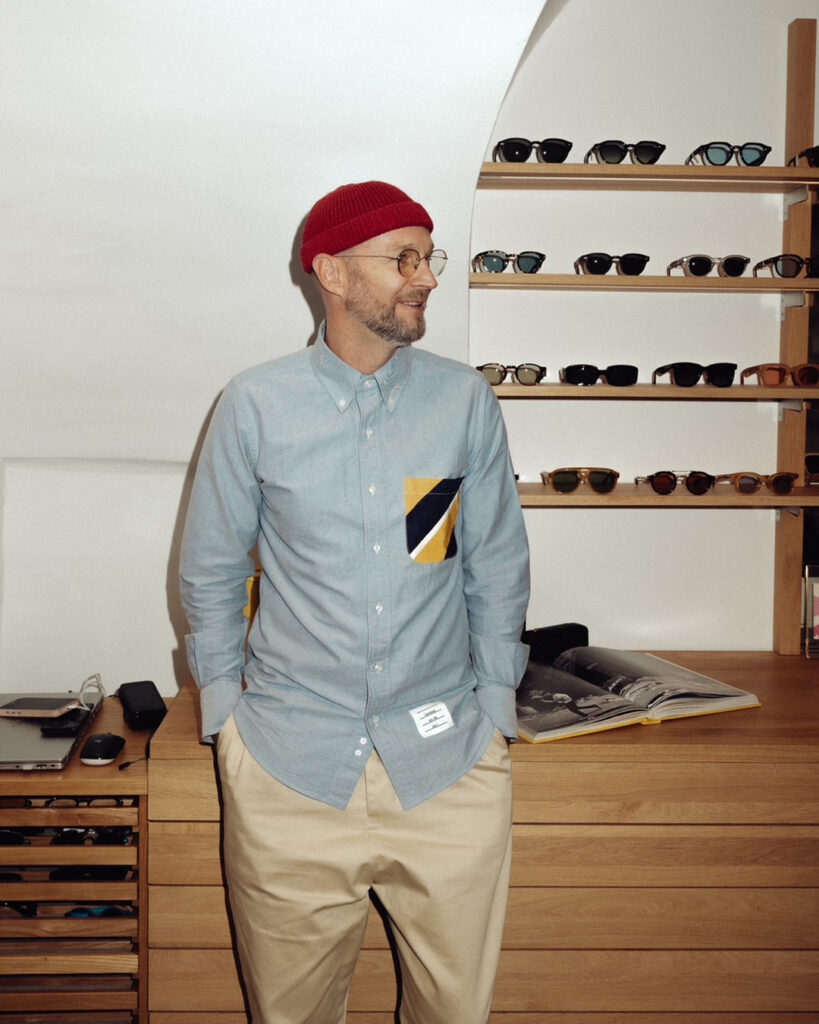
Lasnik grew out of a traditional family-run optical business. But from the very beginning, design, creativity and the search for something distinctive have been an essential part of what we do. We are passionate opticians, but we are equally passionate about eyewear itself.
Over time, that passion increasingly led to the desire not only to curate existing products, but to create our own.
A defining moment came in 2010. It started with a very specific personal need my father had: he was looking for a different kind of reading glass, and what we had in mind simply didn’t exist on the market. So we decided to develop our own solution. That became seeoo and the idea of “Fast Reading” – a radically reduced, functional reading glass designed to be immediately at hand when needed.
In many ways, this still describes how we think today. We don’t create our own products simply because we want to design another pair of glasses. Usually, it starts with a specific need or a problem. We then try to find the clearest possible answer to it – functionally, aesthetically and technically.
One of our greatest strengths is that we understand eyewear from many different perspectives. We have been working directly with clients for around 30 years. We understand facial anatomy and know how eyewear needs to fit, function and feel. At the same time, we work with design, materials, production and the practical requirements of the optician.
This gives us a very holistic approach. We don’t just think about how a frame looks. We think about how it is worn, how it feels, how it can be adjusted and produced – and ultimately, what it means to the person wearing it.
2. Lasnik positions itself as a curated eyewear studio rather than a traditional retailer. How do you define your curation process?
Our curation is very personal. In many ways, Lasnik represents my own perspective on eyewear, design, style and the cultural moment we are living in.
I have a very clear idea of the aesthetics that interest me, which materials and colours work, how a frame should be made, and which brands feel credible to me.
Of course, we observe trends very closely. We sell fashion, and fashion changes. When smaller oval shapes become relevant again, or proportions, colours and silhouettes begin to shift, we pay attention. But we interpret those developments through our own perspective rather than simply adopting them unfiltered.
There is another aspect that is very important to me: in a way, I don’t only curate products, I also curate the people and stories behind them.
After so many years in the international eyewear world, many professional relationships have developed into genuine personal friendships. With many of the brands we carry, we have known the founders, designers or people behind the companies for years. I want to know who stands behind a product, why someone created a brand in the first place, and what values they genuinely represent.
For me, product, brand and people belong together. That is what defines the selection at Lasnik.
3. You emphasize individuality and expression. How do you translate “eyewear as a statement” into the client experience?
For me, the right pair of glasses is not simply one that fits a person well. That is the basic requirement and, frankly, it should be a given for any good optician.
The more interesting question is: Who is this person?
What is their style? What matters to them? How do they dress? How do they live? Perhaps even: What kind of music do they listen to? What do they want to express – and what do they not want to express?
Eyewear sits right in the middle of the face. It is one of the first things we notice about another person. So, inevitably, it becomes part of how we communicate with the world around us.
Our job is to find that match.
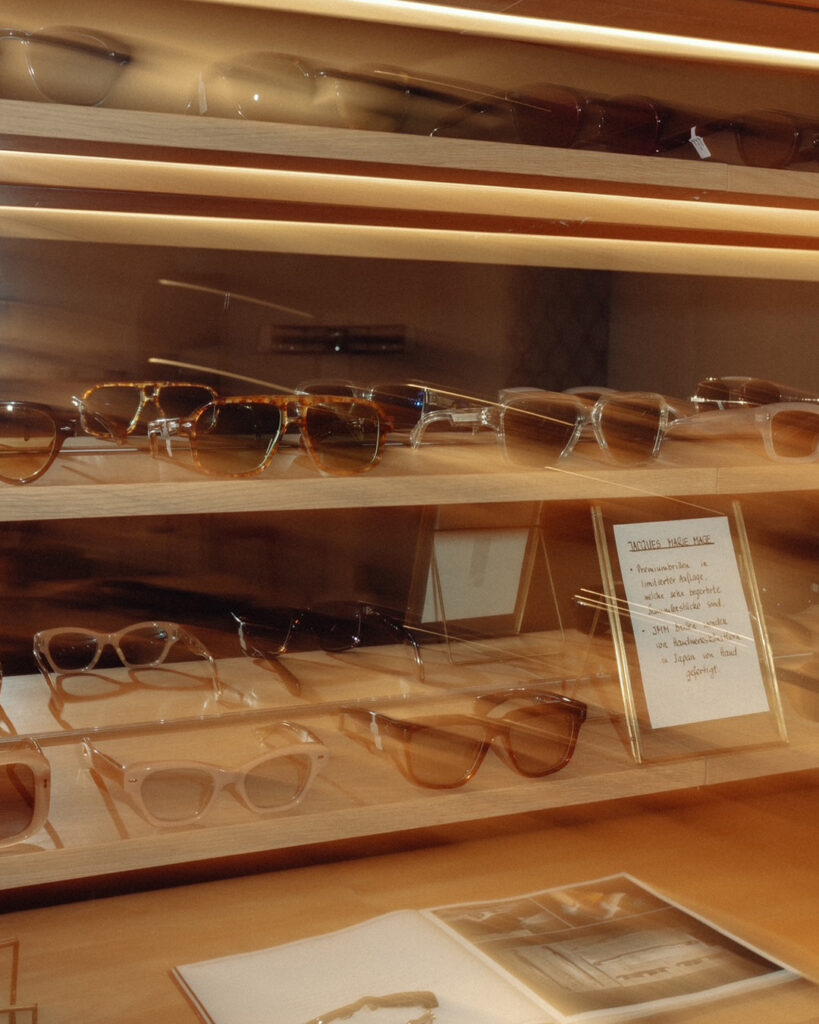
Of course, we consider all the professional and optical parameters: the bridge, width, weight, material, tactility, adjustability and visual comfort. But at the same time, it is about personality. Even the brand we recommend to a client matters. Its aesthetics, story and values should feel right for that particular person.
At its best, eyewear should not feel like a statement that has been artificially imposed on someone. It should feel completely natural – while still changing the person’s presence.
That, to me, is what “eyewear as a statement” really means.
4. How do you balance traditional craftsmanship with advanced optical technologies in your approach?
For me, there is no real contradiction between craftsmanship and technology. Quite the opposite: both serve the same purpose.
Ultimately, the client wants to see as well as possible. The eyewear needs to function perfectly, while at the same time making them feel comfortable and allowing them to present themselves in the way they want to be perceived.
For that, we need experience and craftsmanship. But we also need advanced technology.
We work at a very high technical level because modern measuring and manufacturing technologies allow us to tailor optical solutions to the individual with an extraordinary degree of precision.
Technology does not replace the knowledge of the optician. It expands what the optician is capable of doing.
The essential part is still understanding what this particular person actually needs. Our experience helps us know which questions to ask and what details to look for. Modern technology then gives us the ability to execute the solution with a level of precision that simply wasn’t possible in the past.
For us, high-tech and craftsmanship are therefore not opposites. They are two tools serving the same goal: creating the most individual and uncompromising solution possible for the client.
5. Your portfolio blends niche international brands with your own creations. How do these two directions differ creatively?
With our own eyewear, function is very much at the centre of the design process.
We are not interested in creating expressive objects simply for the sake of expression. We are interested in intelligent, reduced solutions. Fit, weight, adjustability, materials and a clear design language are just as important to us as the aesthetic impact.
This is also directly connected to the way we produce. We are still a family-run company, and we deliberately don’t want to build a huge industrial machine behind our products. The question that interests us is: How can we use simple, intelligent means to create something genuinely good?
That reduction itself creates a distinctive design language.
A good example is our modular principle of combining fronts and temples. The connecting element – including the visible screws – becomes both a constructive and a design feature. We can develop different fronts, materials and applications and combine them with our temple system.
This allows us to work with fronts made from materials such as acetate or buffalo horn, as well as more functional applications. The modular system creates individuality without making the production process unnecessarily complex.
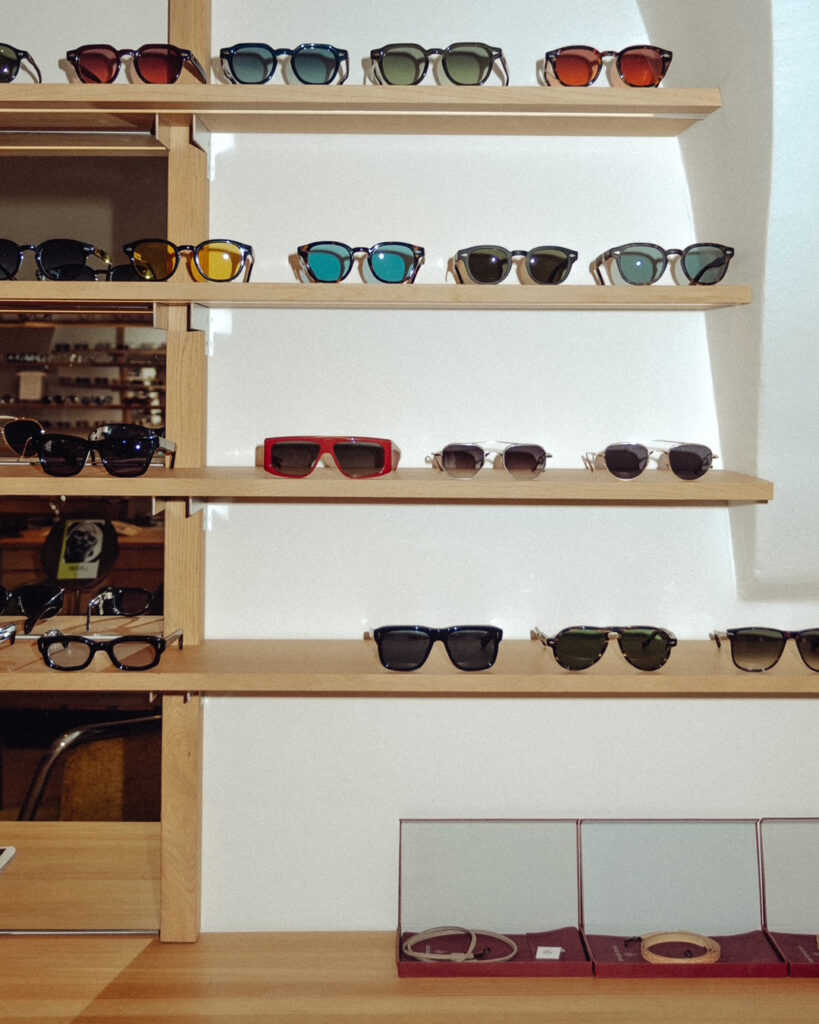
With the international brands we curate, on the other hand, we can present a much broader creative spectrum. There is room for highly expressive, avant-garde or experimental approaches.
That tension is what I find interesting: on one side, our own functional and reduced design language; on the other, a very personal selection of international designers and brands with completely different creative signatures.
6. As a family-driven business with an international outlook, how does this influence your strategic decisions?
The world moves incredibly fast today. Trends emerge, become globally visible through social media almost instantly, and sometimes disappear again before we have even had time to properly understand them.
That makes clarity more important than ever.
Of course, I have gone through different phases over the past decades myself. I have experimented, observed how other companies operate, gained international experience and repeatedly questioned where we want to go. That is part of the process.
With experience, however, you become clearer about what is right for you – and, perhaps even more importantly, what is not.
As a family business, we cannot and do not want to follow every movement in the market. Our strength lies in remaining flexible and working with a manageable structure. That applies to our products as much as it does to our strategic decisions.
At the same time, international and interdisciplinary exchange is extremely important to me. I have been travelling within the global eyewear industry for many years, visiting trade shows and meeting designers, manufacturers and brands. But for me, inspiration should never stop at the boundaries of our own industry.
We look at architecture, product design, fashion, sneakers, functional outdoor clothing, bicycles, materials, technology and many other fields. Often, developments emerge there that later become relevant to our own work.
Even more important are the people behind those ideas. We genuinely enjoy exchanging ideas with people from completely different disciplines. When similar values, passion and a shared attitude come together, that is often when the most interesting ideas and synergies emerge.
For me, this ability to look beyond the boundaries of our own industry is an essential part of our development.
We observe change, we engage with it intensively – but we translate it into our own world.
If there is one constant in our industry, it is change. Our task is not to resist that change, but to maintain a clear point of view within it.
And there is one value that I believe is becoming increasingly important: authenticity. The faster and louder the world becomes, the more important it is to genuinely know what you stand for – and to live by it consistently.
7. In a market driven by trends and volume, how do you maintain exclusivity and a strong design identity?
That is genuinely a challenge today. And precisely because of that, I think it is essential to observe the market very closely while constantly questioning it.
Never simply be satisfied. Never accept something just because it works at the moment or because everyone else is doing it.
Today, it has become relatively easy to create a new brand, build a website and make a product visible internationally. Fundamentally, that is a positive development because it allows many new ideas to emerge. At the same time, however, it makes it more difficult to recognise what truly has substance.
So when I discover a new brand, I ask a lot of questions: Who is behind it? Why was it created? Who designs the products? Where and how are they made? Is there a genuine idea behind it? Is there passion? Is there a point of view? Or is the primary motivation simply to build a business as quickly as possible?
That may sound strict, but for me it is essential. In the long term, I can only sell and represent something I genuinely believe in.
And that is also how I see part of our role as a curated studio. We make a preselection from what has become an enormous international offering. We filter.
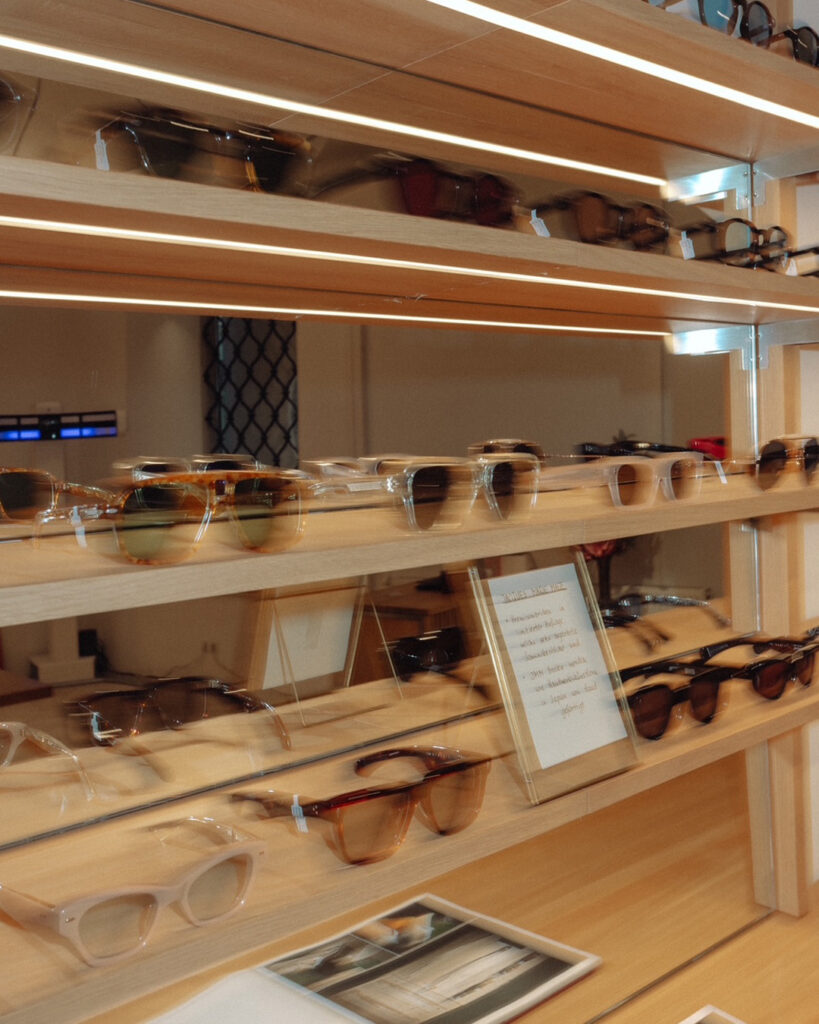
For me, exclusivity therefore does not necessarily come from limitation or a high price. Exclusivity comes from selection.
Of course, our experience plays a role in that. But having spent 30 years in an industry does not automatically mean that you are still relevant today. Experience only has value if you remain curious.
I still have to engage every day with what is emerging, which new brands are appearing, how technology is evolving, how design and fashion are changing, and what is happening beyond our own industry.
Experience then helps me put all of that information into context. It becomes a kind of compass – but you still have to keep moving every day.
Ultimately, I always come back to authenticity: products and people with a genuine idea and genuine passion behind them. If I can feel that myself, I can also communicate it credibly to our clients.
8. How do you see the eyewear market evolving in the coming years?
I think we are currently seeing a very interesting counter-movement.
On one side, everything is accelerating. New brands can emerge within an incredibly short period of time. Images, trends and aesthetics spread globally through social media. And with AI, it is becoming increasingly easy to create entire visual worlds, stories and brand identities.
At the same time, I believe this is creating an increasingly strong desire for what is real.
People will ask more questions: What is authentic? Who is genuinely behind a product? Where does it come from? Which parts of its story and values are real?
I believe this represents a major opportunity, particularly for independent brands and opticians.
That does not mean trends will become irrelevant. We work with fashion, so we have to understand and recognise trends.
If eyewear becomes smaller again, if oval silhouettes return, or if colours and proportions shift, of course we respond to that. We also incorporate these developments into our own models when they make sense within our design language.
But we don’t turn everything upside down every six months.
And I believe the very idea of “the one trend” has changed. Today, many different aesthetic movements exist simultaneously. There is no longer necessarily one frame shape that suddenly everyone has to wear.
That makes the role of the optician much more interesting.
It becomes less about simply showing a client what is currently fashionable. Instead, it is about filtering through all these simultaneous possibilities and finding exactly what fits that individual, their style and their life.
Again, experience helps us here. Not because we believe that after 30 years we know everything. Quite the opposite: you have to remain curious and continue to evolve. But when you have seen trends emerge, disappear and return over several decades, you become better at putting new developments into perspective.
And to do that, you have to look far beyond the eyewear industry.
Architecture, fashion, product design, sport, outdoor culture, sneakers, bicycles, new materials and technology – all of these fields influence one another today. Some of the most interesting developments happen precisely at these intersections.
That is also why I believe collaborations and synergies will become even more important in the future. When people or companies with different areas of expertise but similar values come together, they can create things that neither of them could have developed alone.
That is exactly what interests us.
For me, the future is therefore not about chasing every trend faster. It is about being open enough to recognise change early, experienced enough to put it into context, and clear enough to embrace only what you truly believe in.
What emerges from Martin Lasnik’s perspective is a vision of independent eyewear built on discernment rather than noise. Technology matters. Trends matter. Global exchange matters. But none of them can replace the human ability to look closely, ask better questions and choose with conviction. In Lasnik’s world, the most powerful frame is not necessarily the loudest or the rarest, it is the one that feels unmistakably true to the person wearing it.

 English
  French
  Italian
  Spanish
  Portuguese
  German
  Korean
  Japanese