


The Brussels-based eyewear hunter is turning forgotten factory stocks, unfinished components and industrial archives into contemporary frames. Its latest move: a temporary Marseille store and a new model created with Focus Focus.
Have you ever wondered whether a pair of glasses could be discovered like a forgotten case of vintage wine, buried in an archive, waiting to be uncorked and reinvented?

For Nicolas Musty, founder of Brussels-based Bidules, this is less romantic fantasy than daily business. His company searches the cellars, attics, storerooms and abandoned factories of Europe’s historic eyewear-producing regions, looking for frames and components that never reached a customer.
Some discoveries are complete glasses. Others arrive as unfinished metal structures, loose temples, hinges, lenses or anonymous fronts that have spent half a century inside a wooden crate. Bidules buys what it considers worth preserving, then repairs, adapts, coats, assembles or transforms it in its Brussels workshop.
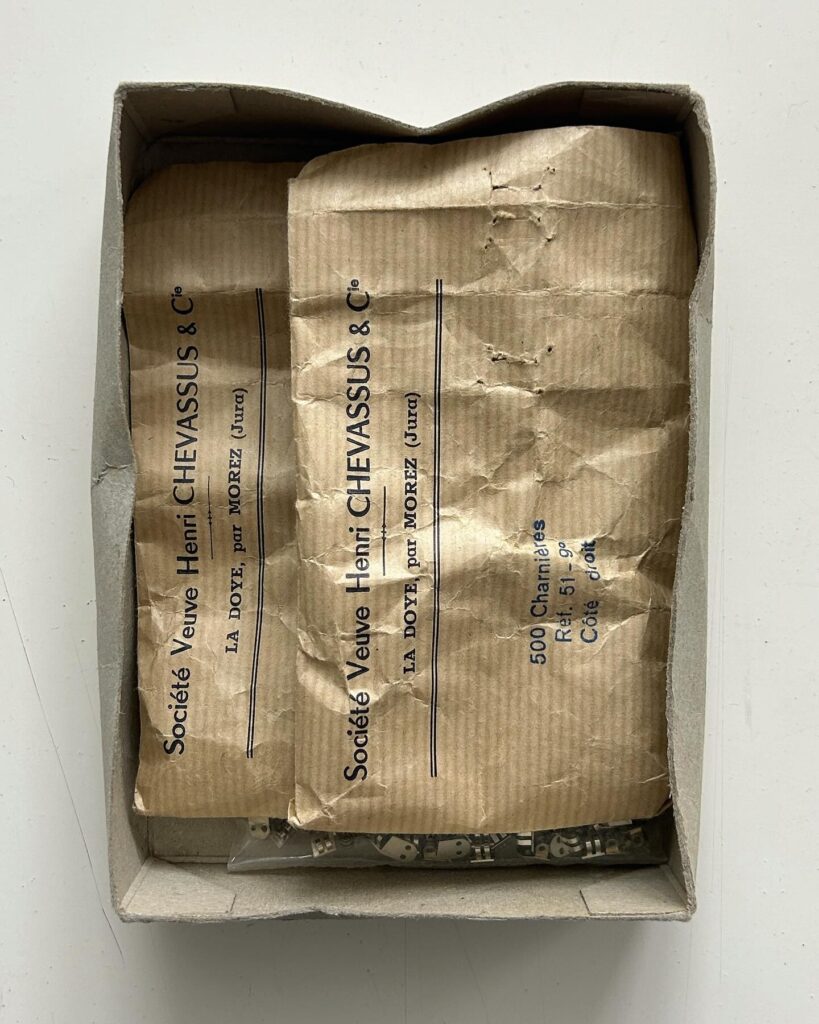
“We buy complete frames, raw metal frames to be coated and spare parts to reassemble, everything we find interesting and believe is worth another spin.“
The resulting glasses are neither conventional vintage nor newly manufactured fashion. They occupy a more interesting territory: objects from the past, technically and culturally reactivated for the present.
This September, that philosophy has travelled south. Bidules has opened its first temporary space in Marseille in collaboration with independent optical boutique Focus Focus. At the centre of the project is mod.468, a frame developed jointly from a stock of unfinished 1970s fronts and assembled by hand using original components.

An Inheritance, Not a Moodboard
The story of Bidules did not begin with a branding exercise, a trend forecast or a desire to launch another eyewear label.
“No rocket science. I admire what has been done in eyewear and optics over the last 150 years, the industry, the untold stories, brands, objects and people who shaped its evolving landscape. I always want to work with what exists.”
That instinct is rooted in four generations of family history. Musty grew up around the optical store opened by his great-grandfather in southern Belgium in 1934, which is still run by his mother today.
The store was where he absorbed the small, pragmatic acts of reinvention that independent opticians once practised naturally. Unsold optical frames could be fitted with tinted lenses and transformed into sunglasses for the summer. A damaged frame was repaired rather than discarded. Products were customised, adapted and sold because the optician trusted their construction, not because a marketing calendar required a new collection.

“I guess I’m part of that generation that believes the good-old pots make the best soup, but make it spicy, please.”
For Musty, these practices offered more than a lesson in sustainability. They represented a form of independence: the freedom to curate differently, develop a distinctive position and build a closer relationship with a local community.
“Repair, customise, hack, sell products you trust. Try to find the shortcuts. That has always been around me. I believe it is still present in the small independent stores that are worth visiting today.”

Bidules began with approximately 100 untouched frames discovered in the family basement: 1980s and 1990s models by names including Metzler, Rodenstock, Neostyle and Cazal. From there, Musty travelled to France’s Jura region in 2013 and to Cadore, in northern Italy, in 2018.
Those journeys exposed him to something larger than vintage aesthetics. The factories, subcontractors and small manufacturers he encountered represented an industrial landscape that had largely disappeared, taking generations of specialist knowledge with it.
“I could never back out. The histories and heritage behind these small and medium-sized manufacturers and subcontractors stuck with me.”

The Archive as a Supply Chain
Asked what makes Bidules different from traditional eyewear brands and retailers, Musty’s answer is characteristically economical:
“You tell me.”
The clearest distinction may be that Bidules reverses the industry’s usual sequence. A conventional brand designs a seasonal collection, orders new production and creates demand around the resulting inventory. Bidules begins with what already exists, often in unpredictable quantities and conditions, and builds its product, story and commercial proposition from there.

The company’s sourcing process combines industrial research with detective work. Its stocks can come from a factory that has closed, an insolvent distributor or the forgotten storeroom of an optical shop.
“They mostly come from closed-down factories, distributors or optical stores. But there are a million stories.”
A lead might emerge through archive research and systematic calls, through a long-standing regional fixer or from a telephone number scribbled on a drinks coaster.
“It could be a phone number written on a coaster in a bar, some door-to-door searching, systematic data-based calling, or a fixer with whom we have built a relationship over the years.”

On one trip to Oyonnax, a chance conversation with a former factory mechanic led Musty to hundreds of frames manufactured between the 1950s and 1980s by members of SOLO, the Société Oyonnaxienne de Lunetterie et d’Optique, a cooperative established by French manufacturers including Max Pittion, Renor, Bouvier-Jacquiot and Grosfilley.
Other discoveries are less immediately usable. For its FRONTs project, Bidules opened an unmarked crate containing 220 mid-century crown-panto fronts. After inspection, only around 50 were considered suitable. The team then had to locate compatible vintage temples, hinges, screws and rivets before learning how to assemble the disparate pieces safely.
The archive is therefore more than an aesthetic reference. It functions as Bidules’ supply chain, research department, parts library and design studio.

When the Logo Became More Valuable Than the Object
Musty sees Bidules as a response to a structural shift in the optical industry.
“Fifty years ago, the advent of branding and marketing, adding a logo on the temples, basically, disconnected intrinsic value from market value.”
Licensing allowed fashion houses to extend their names into eyewear, but Musty argues that the product’s perceived value became increasingly attached to logos, advertising and brand recognition rather than materials, manufacturing techniques or longevity.
Today, he believes, the number of intermediaries separating factories, opticians and customers has deepened that disconnection.
His proposal is not to romanticise every old frame or reject every contemporary manufacturer. It is to shorten the distance between expertise, production and consumption.

“I would love to see opticians, and perhaps final customers, organising into cooperatives, going to local factories and taking more shortcuts and risks. It would be so much more fun for everyone, and create much more added value for all the interested parties.”
Behind the humour is a sharp diagnosis of market polarisation. Musty believes genuinely good products and specialist services are becoming accessible to fewer people, while the cheapest segment continues to compete primarily by becoming cheaper in materials, manufacturing and service.
“The social divide is huge. Good products and services are accessible to an ever-smaller group, the cheapest is always becoming cheaper, in every way, and there are fewer and fewer good deals in the middle.”
Bidules’ response is built around curation, technical knowledge and human service rather than volume. The company also resists reducing its thousands of archived frames to a conventional e-commerce catalogue. Fitting, adjustment, eye examinations and the relationship between a frame and a particular face remain central to its model.

Marseille and the Birth of mod.468
The collaboration with Focus Focus makes strategic as well as aesthetic sense. Located in Marseille’s sixth arrondissement, Focus Focus positions itself as an alternative to an eyewear landscape dominated by mass-market branding.
Its curation favours independently made frames, specialist materials and production in France, Italy and Japan, while its workshop provides polishing, welding, sandblasting, restoration and tinting. Like Bidules, Focus Focus treats the optician as a curator and technician rather than simply a point of sale.
Their shared approach materialises in mod.468.
The frame began not as a sketch or a trend forecast, but as a stock of incomplete fronts manufactured during the 1970s. Bidules and Focus Focus developed the final design and assembled it by hand using original wire-core hinges and other deadstock components.
The result is both an archival object and a contemporary collaboration. It demonstrates how deadstock can move beyond simple resale: existing materials become the starting point for new authorship without losing their industrial history.

The mod.468 launch anchors (EN TRANSIT), Bidules’ temporary Marseille store at 88 Boulevard Vauban, 13006 Marseille, open from 4 to 26 September 2026, Tuesday to Saturday from 11:00 to 19:00.
More than 250 deadstock frames spanning the 1940s to the early 2000s have travelled from Brussels for the project.

The opening extended the story beyond eyewear. An exhibition co-curated with Posterita brought together work by designers Arnaud Eubelen and Melissa Mariller and photographer Mathilde Hiley, while artist Céline Chiasera contributed a live performance. The result positioned the pop-up somewhere between optical store, design exhibition and temporary cultural archive.
It is not the first connection between the two businesses. Focus Focus is among the international stockists of Bidules’ first book, 3000 Days of Archives Related to the Optics and Glasses Frame Industry. Developed from an archive the team began building in 2018, the publication documents overlooked brands, tools, objects and people from the optical trade.

The Value of What the Industry Left Behind
In an industry conditioned to associate innovation with new production, Bidules proposes a different equation.
Novelty can come from research. Design can begin with limitation. A frame can become desirable not because a logo creates artificial scarcity, but because its materials, construction and route back into circulation cannot be easily repeated.
For Musty, the future of Bidules is not necessarily about becoming a conventional global eyewear brand. It is about expanding the archive, preserving more industrial knowledge and creating new encounters between forgotten objects and the people who will wear them.
“Sharing thousands of untold stories and finding millions of underrated glasses would be awesome.”
Whether those glasses are found through data, a fixer, an old newspaper, an abandoned factory or a stranger in a bar matters almost as much as the final object. Every discovery adds another fragment to an industrial history that official fashion narratives have often overlooked.
The future of eyewear, in other words, may not need to be manufactured from scratch. Nicolas Musty believes it may already be waiting in a basement: dusty, unfinished and ready for another life.



 English
  French
  Italian
  Spanish
  Portuguese
  German
  Korean
  Japanese