


LAPIMA’s Little Black Glass collection shows how independent eyewear can move toward simpler, more wearable shapes while keeping its design identity intact.
For years, independent eyewear was judged by what could stop someone in front of an optical store. An oversized silhouette or an improbable colour could do that job in seconds. The frame would earn the best spot in the window, appear in the store’s photographs and tell passers-by that there was something different inside. Then a customer would come in, try it on and ask whether it came in a smaller size or in black.
A stagnant market and declining sales have pushed opticians to drop brands built around statement eyewear. These were frames designed for the runway or a single night out. Many never sold at all.
That second moment is increasingly where the market is being decided. The era in which the statement frame set the direction for the rest of the collection is ending. The centre of gravity is moving towards the street, where frames have to work with the clothes people own, the faces they see in the mirror and the lives they already lead. A pair of sunglasses that comes out of its case four mornings a week has a different kind of presence from one that spends a season in a shop window.

Independent opticians are feeling that shift at the buying table. A frame’s ability to anchor a display used to carry considerable weight. Increasingly, buyers are asking what they can sell and reorder, and which of those pieces still gives a customer a reason to choose one brand over another. Buying a wall of interchangeable black rectangles would solve very little. The opportunity is to find familiar shapes with enough character to justify their place in a carefully chosen assortment.

That puts pressure on brands to work out what their design DNA actually consists of. In an exaggerated frame, the outline can do most of the work. In a simple square or a restrained cat-eye, identity has to come through in the proportions, the way the acetate is carved and how the front catches the light. LAPIMA’s Little Black Glass collection makes that distinction unusually easy to see.

Black is back
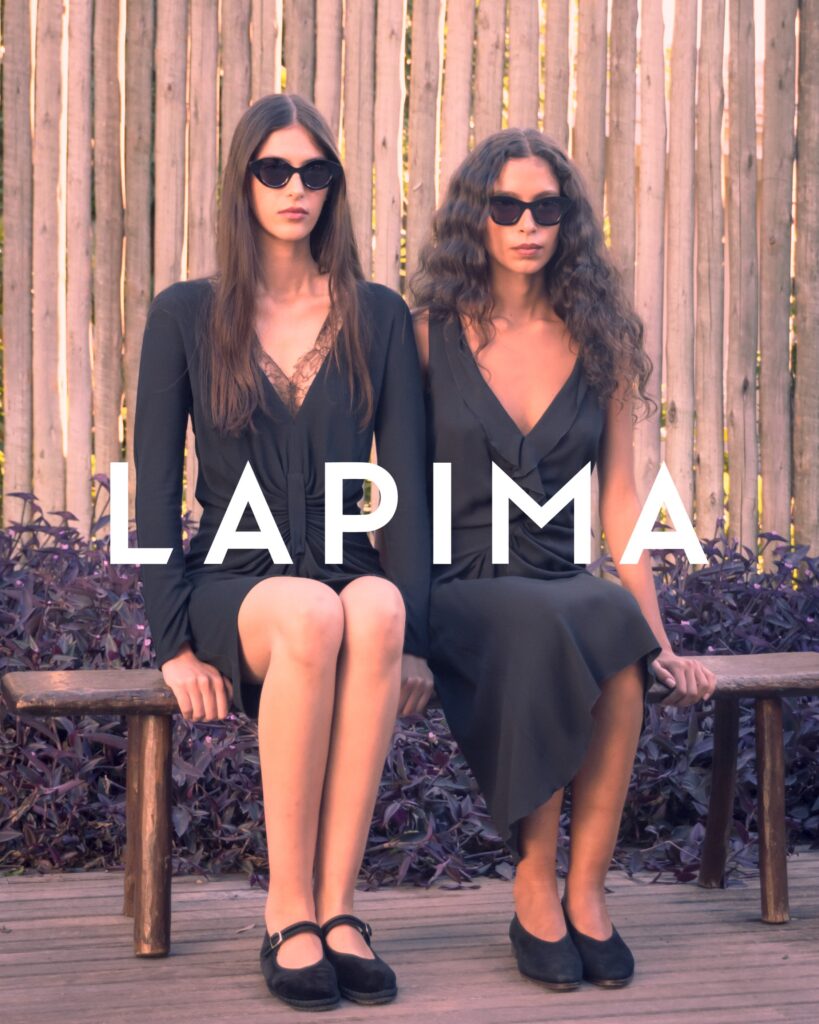
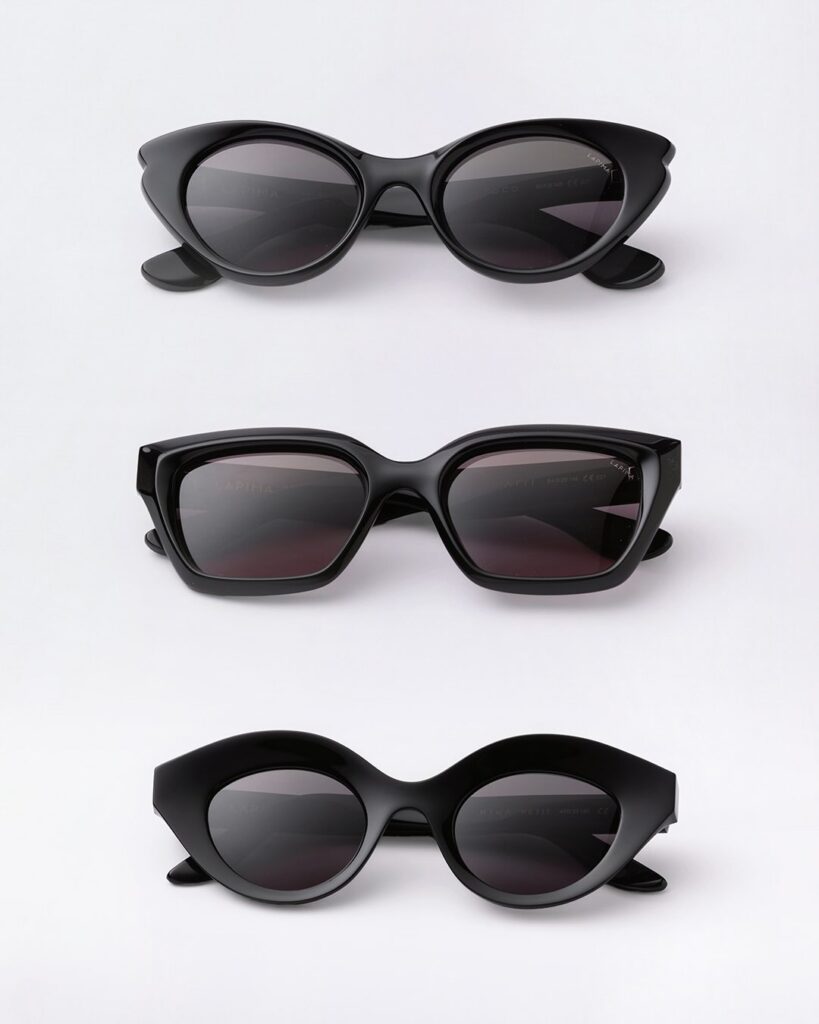
LAPIMA takes the logic of the little black dress and applies it to sunglasses. The analogy is about how often you reach for something. The dress earns its place in the wardrobe because you know what it will do for you. With Little Black Glass, LAPIMA brings that idea to a selection of its own silhouettes, unifying them through high-gloss black acetate and dark charcoal lenses. The catalogue calls the collection Little Black Glass and uses Black Shadow as the colour name on individual models such as Tessa Petit.
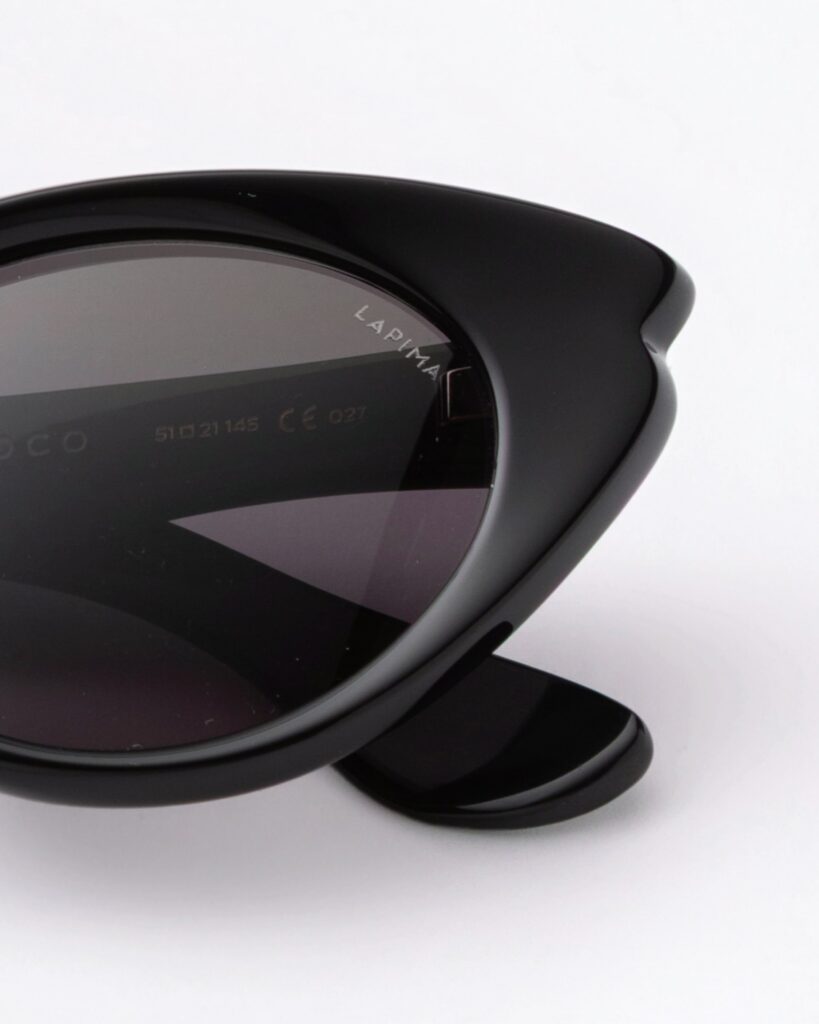
The pairing works because the two surfaces handle light differently. The lenses give the front a soft, almost gunmetal depth, while the polished acetate picks up highlights along its curves. Across the collection, a subtle cat-eye carries that highlight upwards and an architectural square lets it travel across a broader surface. With the palette held constant, the differences between the shapes become easier to read. LAPIMA’s hand-carved surfaces and cotton-wheel polishing are particularly visible here. They give the black a sense of volume that a flat silhouette would lose.

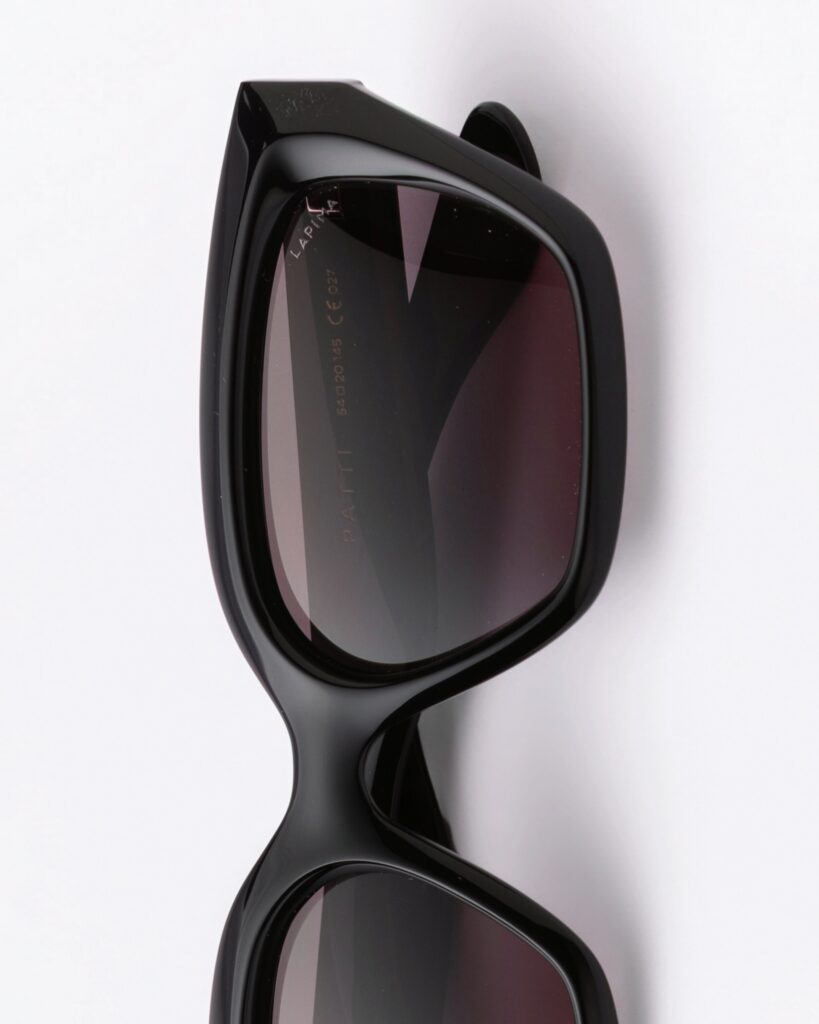
Tessa Petit makes the point most clearly. Its square outline has an immediate familiarity, and LAPIMA describes it as a tribute to the 1970s. Look at it from an angle and the concave front changes the way that square reads. The eye follows the surface inwards, giving a familiar shape a sculptural quality. The black finish lets that detail emerge gradually. It is easy to imagine wearing Tessa Petit with the same clothes you wore yesterday and still noticing something about the frame a month after buying it.
That is the commercial promise of this shift for independent opticians. A customer can come in asking for a classic black sunglass and leave with something recognisably LAPIMA. The familiar shape makes it easy to try on. The carving, proportions and finish give the customer a reason to remember which pair it was. Over time, the frame the optician can sell again becomes the one the customer is seen wearing again. For a brand built on recognisable design, that is a more durable kind of visibility than a season in the window.



 English
 French
 Italian
 Spanish
 Portuguese
 German
 Korean
 Japanese
 Dutch