

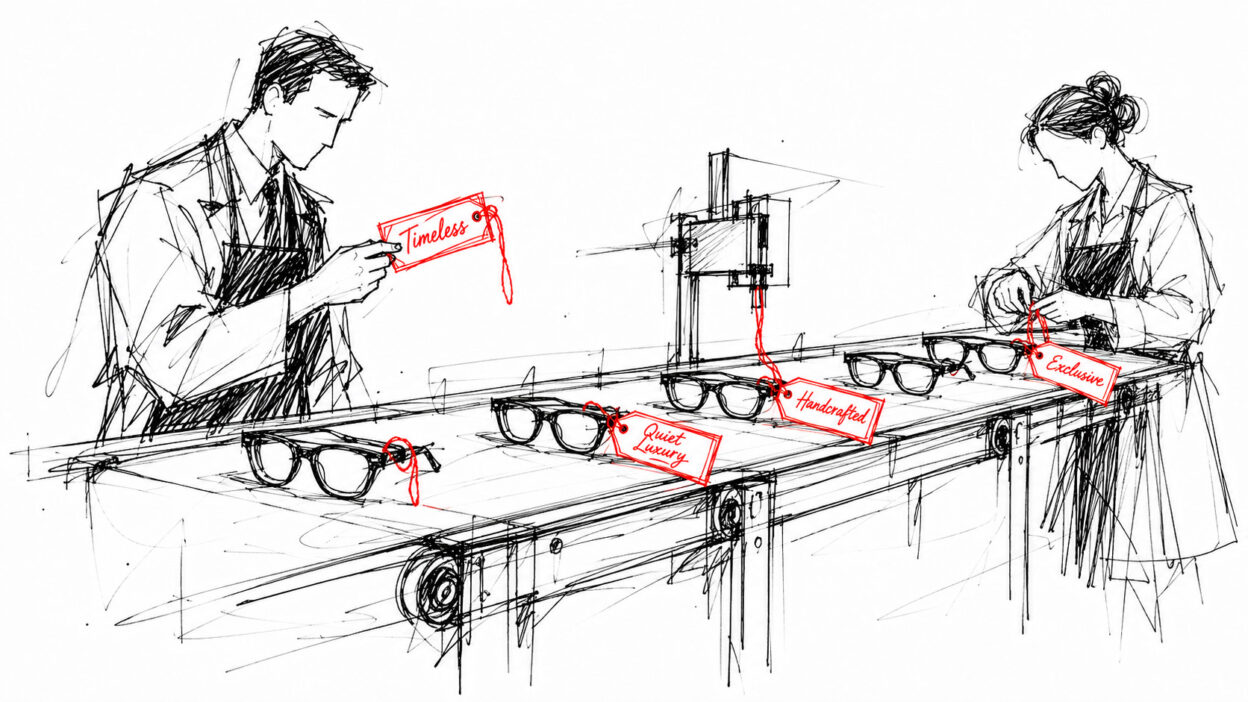
When did the language of eyewear become more interesting than the product itself?
There is a particular talent our industry has developed over the years. The ability to make something rather ordinary sound extraordinary.
We have become exceptionally good at dressing up the obvious.
Handmade in Japan. Japanese titanium. Timeless elegance. Understated sophistication. Quiet luxury.
The vocabulary is impressive. The substance? Increasingly difficult to find.
And perhaps that is the problem.
Somewhere along the way, we started confusing the language of quality with the existence of originality.
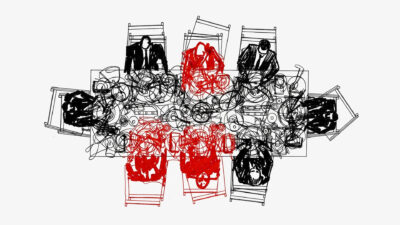
Buzzwords have become the industry’s favourite tablecloth. Beautifully presented, carefully arranged, and often covering a rather basic table.
Let’s be clear. Craftsmanship matters. It always has. The precision of Japanese manufacturing, the expertise of Italian artisans, the quality of materials, the attention to detail. These are fundamental elements of what makes independent eyewear special.
But that’s precisely the point.
They are fundamental.
In the high-end independent eyewear market, craftsmanship is no longer the exception. It is the expectation.
We have spent years educating retailers and consumers about materials, construction, manufacturing techniques and quality. Yet somehow, brands continue to introduce these same characteristics as though they have just discovered something revolutionary.
Japanese titanium is not a personality.
Handmade is not a creative direction.
And manufacturing excellence, however admirable, cannot compensate for the absence of an idea.
At a certain level of the market, these are simply the standards required to participate.
The conversation should have evolved by now.
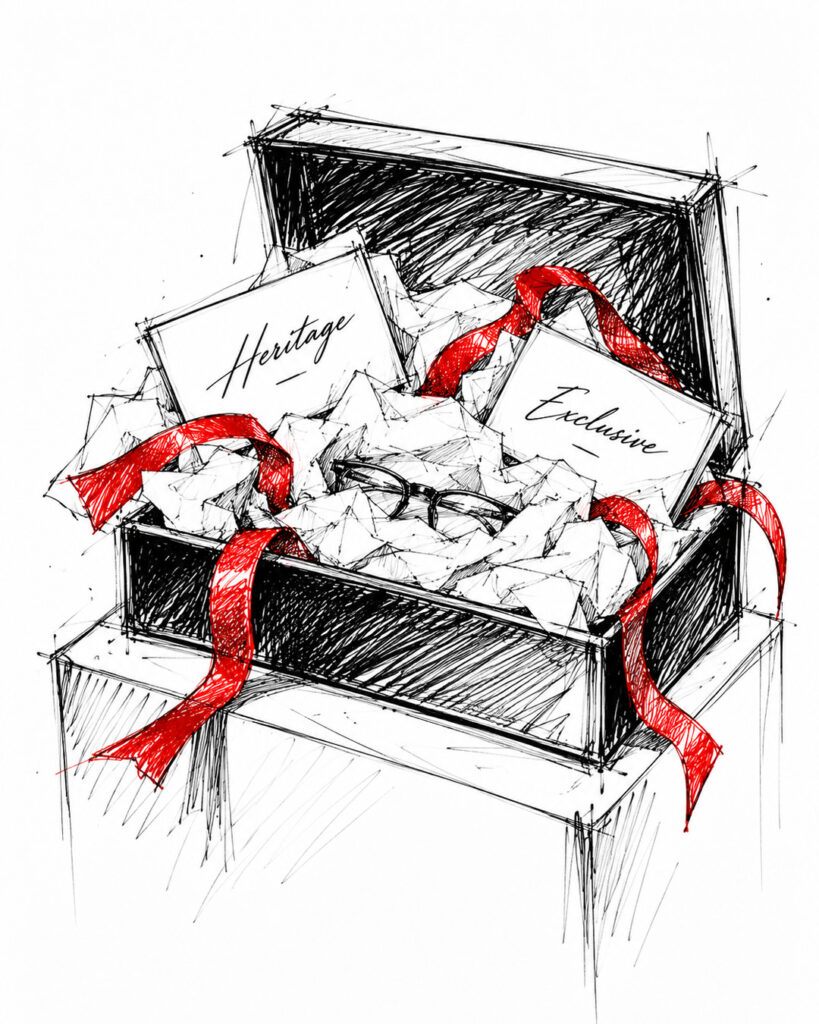
The Difference Between Making Something Well and Making Something Interesting.
A beautifully manufactured frame deserves respect.
But a beautifully manufactured frame that looks remarkably similar to twenty others raises a different question.
What exactly are we celebrating?
There is a growing tendency in eyewear to mistake refinement for innovation. Familiar shapes are slightly adjusted, familiar references are recycled, and familiar narratives are repackaged with increasingly elaborate language.
Everyone seems to be inspired by the same archives, the same decades, the same cultural references.
At what point does inspiration become imitation?
And more importantly, when did we become so comfortable with it?
The independent eyewear industry was built, in part, on the promise of offering something different. A departure from mass-market thinking. An alternative to predictable design and commercial uniformity.
That independence should represent more than a distribution model or a price point.
It should represent freedom of thought.
Freedom to experiment. To challenge proportions. To develop recognizable design languages. To create objects with identity rather than simply objects with excellent specifications.
The question should no longer be where a frame was made. It should also be why it needed to exist.

Quiet Luxury. The Phrase That Refuses to Retire.
And then, of course, there is quiet luxury.
Possibly the most exhausted expression in the contemporary vocabulary of fashion and eyewear.
It had its cultural moment. We understood the references. We understood the aesthetic. We understood the appeal of discretion.
But we are approaching 2027.
Surely, we can move the conversation forward.
Removing a visible logo from a gold-plated frame does not automatically make it quiet luxury.
Neither does photographing a conventional acetate frame against a beige wall, adding a serif typeface and writing three paragraphs about timeless sophistication.
That is not necessarily a brand philosophy.
Sometimes, it’s simply a lack of imagination dressed as restraint.
And before we reach for the inevitable response, “If you know, you know,” perhaps we should ask what exactly there is to know.
Because mystery is only interesting when there is something worth discovering.
Discretion can be powerful. Minimalism can be extraordinary. Restraint can be one of the most sophisticated forms of design.
But those qualities require intention.
Having less to say is not the same as having something meaningful to say quietly.
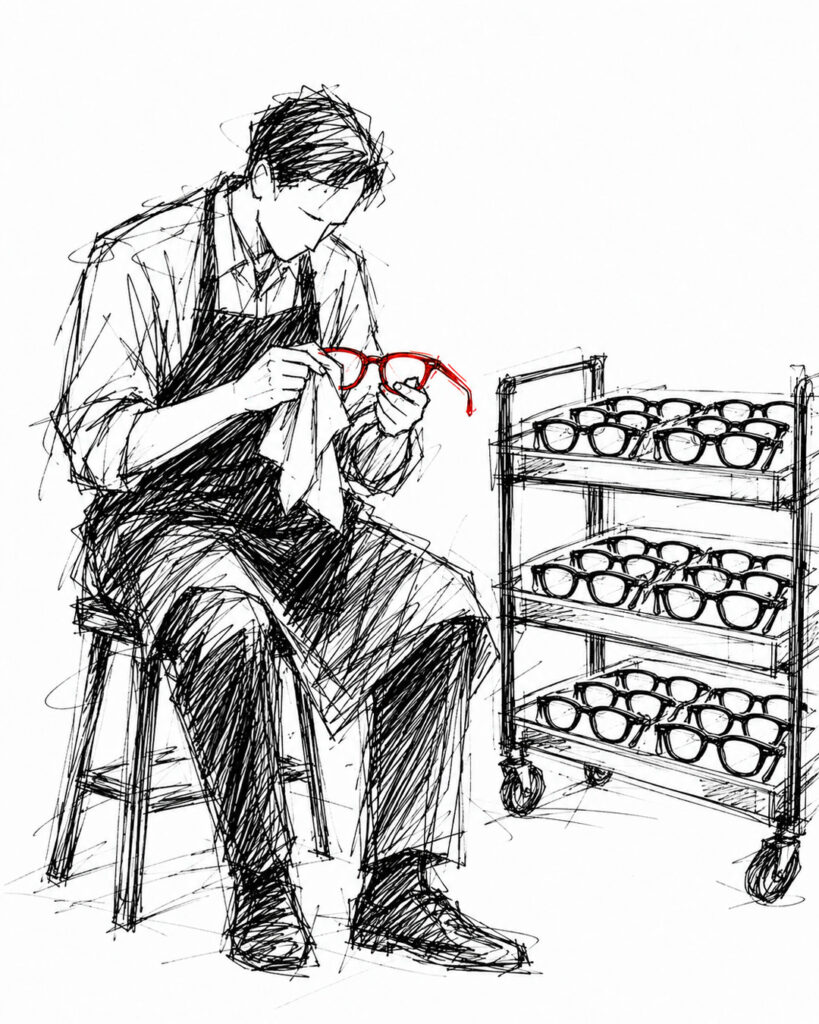
We Don’t Need More Adjectives. We Need More Ideas.
What we should be demanding from our industry is not another vocabulary exercise.
We need stronger brand DNA.
Design development that goes beyond changing a bridge, adjusting a temple or revisiting a shape we have already seen countless times.
We need brands to develop their own visual signatures. Not simply through logos, but through proportions, construction, colour, creative direction and a point of view that is immediately recognizable.
We need more interesting marketing.
Campaigns that engage with culture rather than endlessly reproducing the same luxury codes. Storytelling that introduces us to the people, decisions, tensions and creative processes behind the product.
Show us what inspired the collection.
Show us what was rejected before the final design.
Show us the creative risks.
Give retailers something worth discussing beyond the technical specifications. Give consumers something worth connecting with beyond the country of manufacture.
And perhaps most importantly, give the product enough identity that the marketing doesn’t have to work overtime explaining why it matters.
Because great storytelling doesn’t manufacture substance.
It reveals it.
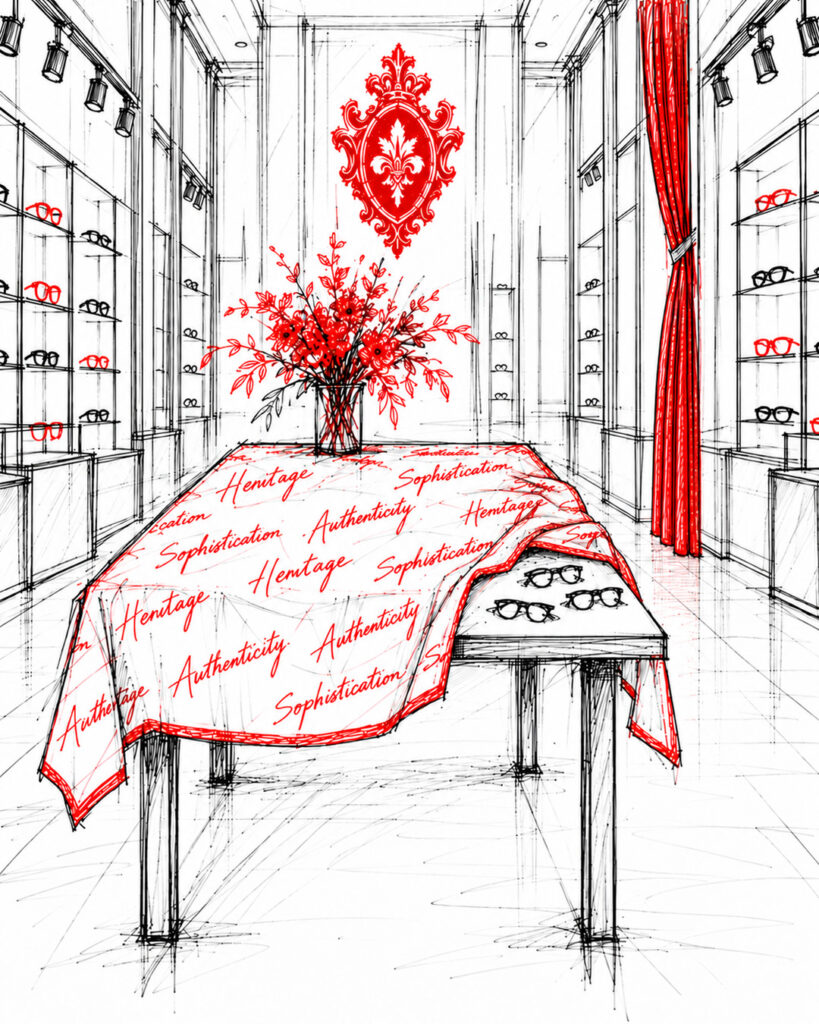
The Customer Has Evolved. Has Our Language?
There is another part of this conversation that deserves attention.
We sometimes speak to consumers as though they are discovering quality eyewear for the first time.
As though the mention of Japanese titanium should immediately justify a premium price. As though the word handmade should end every discussion about value.
But the consumer has evolved.
They have been exposed to independent brands, designer objects, fashion, architecture and product culture. They have access to information, references and alternatives that were once reserved for industry insiders.
They recognize familiar shapes. They compare brands. They question pricing. They notice when different labels seem to be telling exactly the same story.
Of course, craftsmanship remains part of the conversation. It should.
But it cannot be the entire conversation.
And for those of us working with retailers, this matters enormously.
We cannot continue asking stores to invest in new brands while presenting them with the same arguments, the same aesthetics and increasingly similar products.
A retailer does not simply need another well-made frame.
They need a reason to give that frame space.
A reason to introduce it to their clients.
A reason to believe that the brand will bring something distinct to their assortment and their business.
That requires considerably more thought than another beautifully written paragraph about heritage.
Perhaps the next evolution of independent eyewear has very little to do with inventing another category or finding another fashionable expression.
Perhaps it begins with asking better questions.
What does this brand actually stand for?
What makes its design language recognizable?
What cultural conversation is it contributing to?
What is it bringing to the market that isn’t already there?
And if we removed every reference to craftsmanship, titanium, heritage and timelessness from its presentation, would there still be an interesting story left to tell?
That’s the real test.
Because none of this is an argument against craftsmanship. Quite the opposite. Craftsmanship deserves better than being reduced to a marketing cliché.
It deserves to support extraordinary ideas.
We have the manufacturing expertise. We have talented designers. We have retailers willing to champion independent creativity. We have consumers increasingly interested in products with identity and meaning.
What we need now is the ambition to do something more interesting with all of it.
The industry doesn’t suffer from a shortage of beautiful words.
It suffers when those words become a substitute for creative thinking.
The tablecloth has had its moment.
It’s time to pay attention to what’s underneath.

 English
 French
 Italian
 Spanish
 Portuguese
 German
 Korean
 Japanese