

UPDATE:
After publishing the article below, we were reminded that even large brands often struggle to manage a perceived opinion about the market. Following the publication of our post, several employees appeared in the comments defending the campaign, and we subsequently received a private message from Maisie Taylor, Brand Comms at Cutler and Gross.
For clarity, the images referenced in the article were embedded directly from Instagram, where they were originally published, and were not uploaded or hosted on our website.
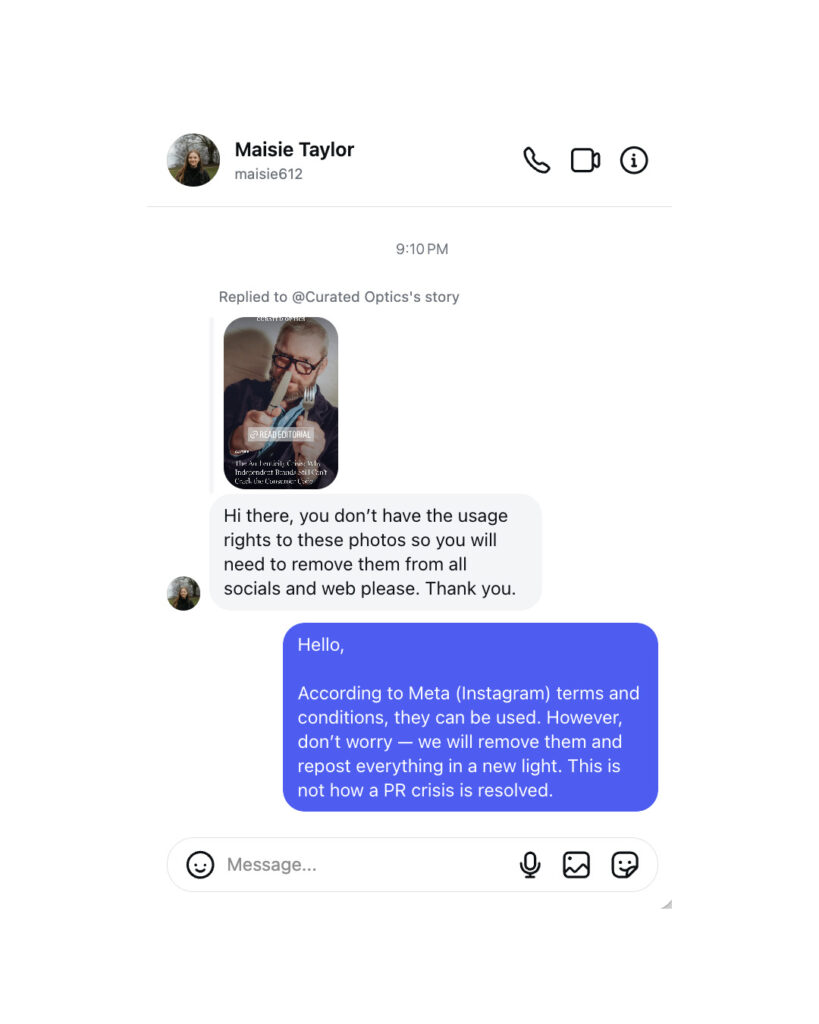
When brands are used to dealing mainly with paid editorial environments, they sometimes appear unprepared for independent commentary and market analysis. In such situations, attempts at removing or restricting content can be interpreted as censorship, which is rarely the right way to address criticism or differing viewpoints.
It is important to note that we never denied that the individual involved in the campaign may be a Cutler and Gross client. Our point was simply to highlight how the campaign might appear from the outside. Looking at the individual’s personal posts, not the campaign material, the frames most consistently worn appear to be from Cubitts, which naturally raises questions about perception and authenticity in the context of a brand partnership.
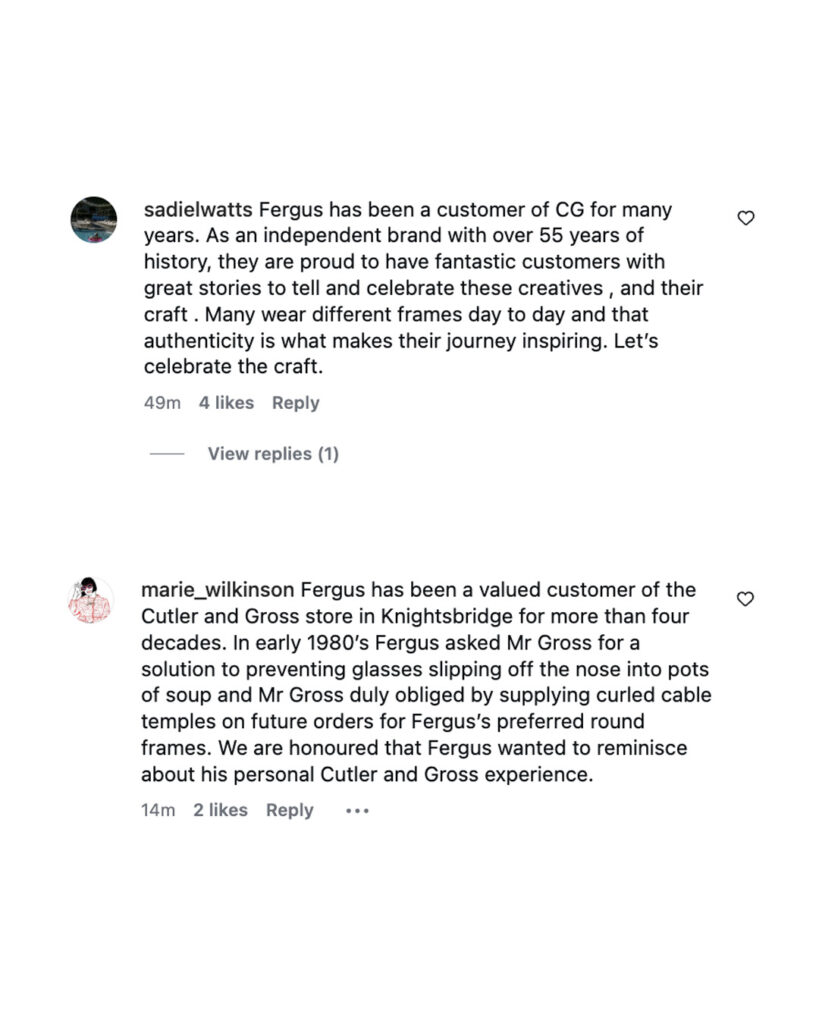
Our observation was therefore about consumer perception, not about disputing personal purchasing habits. However, it seems that open and honest commentary can sometimes be difficult for brands to accept.
Of course, we have complied with the request made to us. The episode nonetheless illustrates a broader issue in the industry: for years many brands have operated in an environment where much of the press coverage was positive and commercially driven. When confronted with independent criticism or a critical perspective, the instinct too often becomes to attempt to remove the discussion rather than engage with it constructively.
Moreover, it unfortunately appears that many brands are still not prepared to truly reach the end consumer, as they continue to focus on controlling the message that comes from them rather than communicating effectively.
ORIGINAL ARTICLE:
For more than a decade, the fashion industry relied heavily on influencers as the fastest route to the consumer. The formula was simple: visibility equals desirability. But as audiences grew more sophisticated, the mechanism began to fracture. Consumers realised that influence could be bought and once that illusion disappeared, so did much of its power.
Independent eyewear brands are now experimenting with a new strategy: collaborations with cultural figures outside the traditional fashion ecosystem. Architects, DJs, chefs and artists are increasingly appearing in campaigns, positioned less as promoters and more as collaborators.
The idea is to embed products within culture rather than simply advertise them.
But authenticity remains fragile.
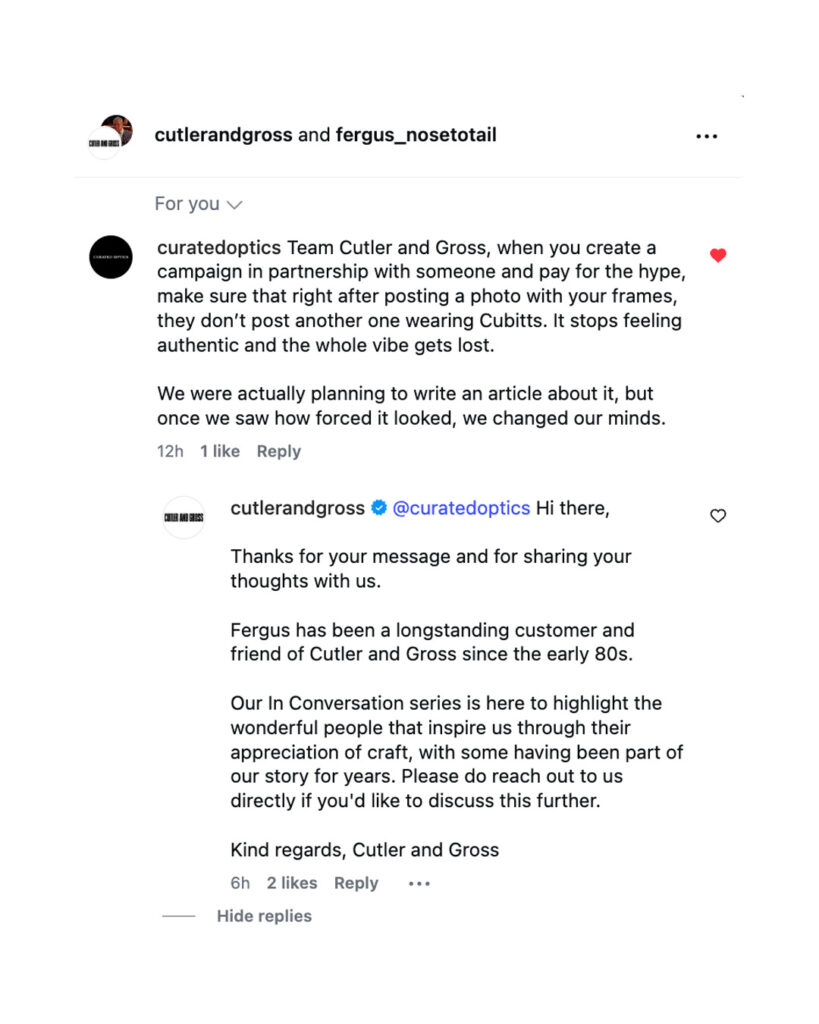
Take the recent collaboration between Fergus Henderson and Cutler & Gross. At first glance, the partnership seemed like a natural alignment between two institutions of British craft. Yet the illusion quickly weakens under scrutiny. On the chef’s own Instagram feed, a photo from yesterday shows him wearing Cubitts glasses. In today’s collaboration post, he appears in Cutler & Gross.
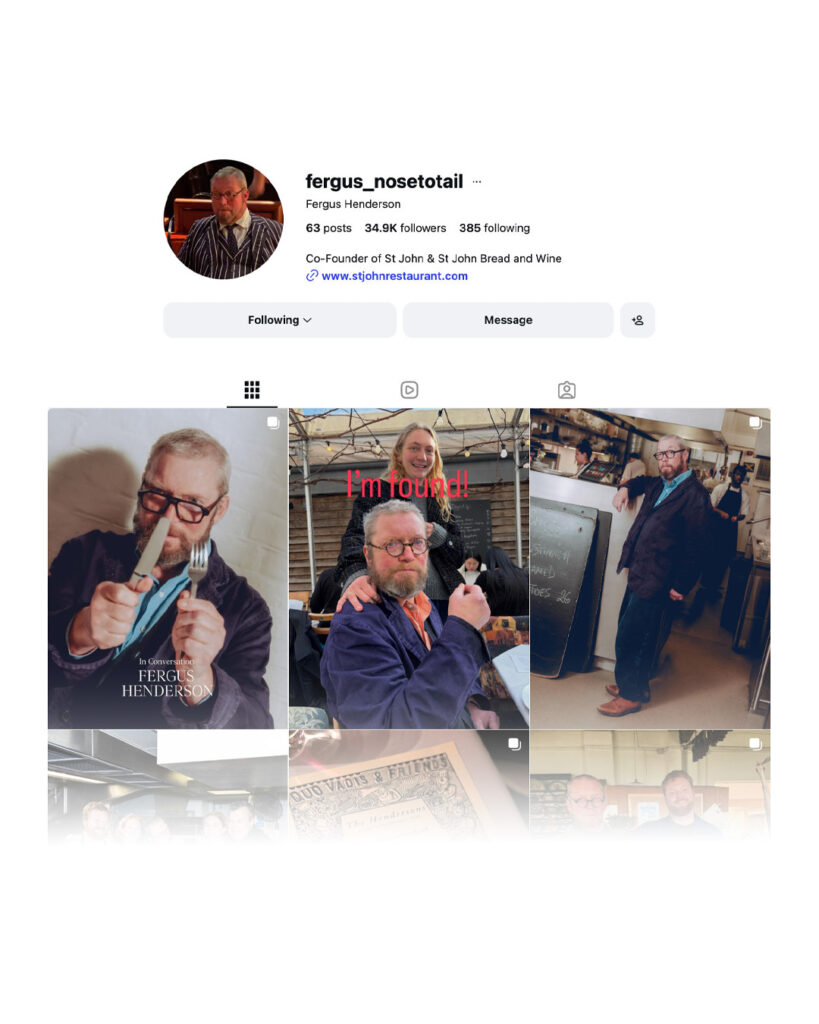
The collaboration may indeed be natural, according to discussions with Cutler & Gross, their PR management confirmed both in public comments and in an email that it is not a sponsored collaboration. However, if the execution is not handled correctly, the end consumer has no way of knowing these details, and the collaboration risks losing the very authenticity that gives it its power.
“I just wanted to pass on a message in response to the comment left on the Cutler and Gross Instagram account on the Fergus Henderson post.
Thanks for sharing feedback, but we just wanted to let you know that Fergus has been a longstanding customer and friend of Cutler and Gross since the early 80s.
Our ‘In Conversation’ series are editorial features (not paid for) which highlight inspiring figures, with some having been part of our story for years.“
The abrupt switch exposes the mechanics behind the collaboration. What initially reads as organic endorsement begins to look more like a paid placement and the narrative collapses.

By contrast, Ahlem recently experimented with a subtler approach. In a campaign featuring architect Maja Bernvill, the glasses never appear on the subject’s face. Instead, they rest casually on a table within the environment. The imagery feels observational rather than promotional, suggesting a lifestyle rather than declaring a product.
Eyewear brands, however, face a deeper structural challenge. Many still struggle to understand the intersection between PR and creative direction. The internet has shifted expectations: it is now a content market before it is a product market. Yet many brands continue to operate as if the opposite were true.

The result is often a visible disconnect. In many cases, teams lack people who grew up within the digital culture that now shapes consumer taste particularly younger voices who instinctively understand how audiences interpret and react to visual narratives online.
A cultural approach to campaigns can be powerful, but only when it comes from individuals who genuinely understand and participate in those environments. Without that proximity, collaborations and campaigns risk feeling constructed rather than lived. And when authenticity becomes forced and staged, the strategy begins to erode credibility instead of building it.

Even luxury independent brands have relied on carefully engineered cultural pipelines. Jacques Marie Mage, for instance, built much of its early momentum by seeding frames through Hollywood stylists, ensuring appearances in films, television series and on high-profile celebrities. For a time, the strategy generated immense desirability.
But even that form of cultural placement eventually reaches saturation. Once audiences recognise the system behind the scenes, the mystique fades.
Meanwhile, large conglomerates are borrowing aesthetics from the independent sector while deploying entirely different resources. Just as Louis Vuitton tapped Pharrell Williams to reshape its image, Ray-Ban has enlisted A$SAP Rocky to reinterpret its eyewear.
The visual language increasingly mimics independent brands limited drops, artistic collaborations, cultural storytelling yet the scale of corporate machinery behind it often makes the result feel manufactured.
The paradox is clear: authenticity has become the industry’s most valuable currency, yet the more aggressively it is produced, the less convincing it becomes.
Over the past decade, with so much “momentum” and “hype” being manufactured, many brands no longer understand how to recreate the formula. Organized within increasingly corporate structures often without creative directors who are genuinely immersed in those cultural environments they have gradually become disconnected from reality.
For today’s consumer, the difference between cultural participation and cultural marketing is becoming easier to spot. And in an era of constant exposure, the brands that succeed may not be those with the loudest collaborations but those that feel the least constructed.



 English
  French
  Italian
  Spanish
  Portuguese
  German
  Korean
  Japanese