



Founded in 2022 by Kevin Godart-Elbaz the owner of Marbeuf Optique, alongside businessman Jérémie Gamon, whose résumé includes time at Edmond de Rothschild, the brand sits at the intersection of retail instinct and financial discipline. It’s a familiar formula, creative meets corporate, but in Sato’s case, the execution is unusually controlled.
The result is not disruption. It’s calibration.
Riding the Post-Hype Luxury Wave
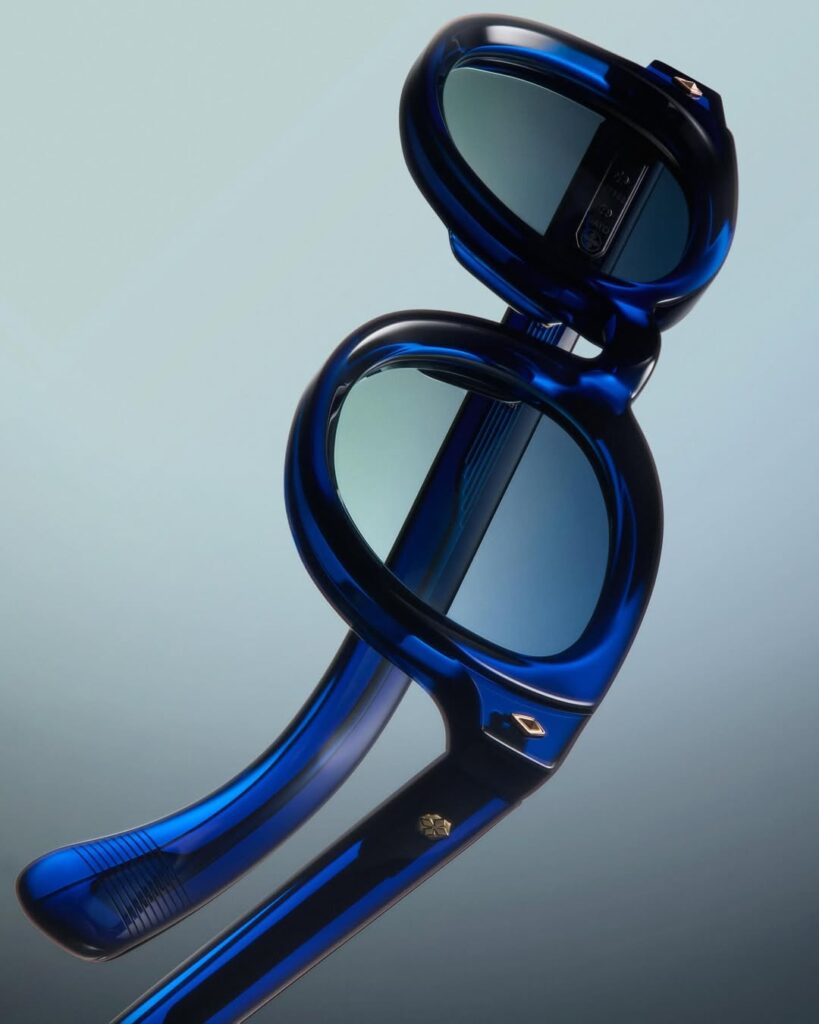
Sato enters a market reshaped by Jacques Marie Mage, which effectively reset price ceilings in eyewear, normalising four-figure frames and margins that once seemed implausible. Alongside Chrome Hearts, it created scarcity-driven demand and, crucially, left gaps in distribution as both brands tightened wholesale accounts.
Sato is one of a new generation moving quickly to occupy that space.

In just over three years, the label has secured placement in more than 250 stores globally, a pace that signals both retailer appetite and a well-executed rollout strategy. Buyers, faced with reduced access to legacy ultra-luxury brands, are actively seeking alternatives that deliver comparable margins without the same allocation constraints.
Sato delivers exactly that.

Critics would argue that the next decade will belong to brands that truly understand social media, not just as a channel, but as a core driver of perception, built through high-impact campaigns. Many labels still fail to grasp that today’s equation is split evenly: 50 percent social media, 50 percent product. Sato is among the few that seem to understand this balance with clarity.
If brands want to reach a new audience and capture a younger consumer, they need to take cues from Sato, moving decisively into social media and understanding that today, product begins with marketing. Top-tier content and visibility are no longer optional; they are the entry point.

Aesthetic Over Innovation
If there is a critique, it is also the brand’s strategy: Sato is not trying to reinvent eyewear.
Instead, it refines a language that already sells.
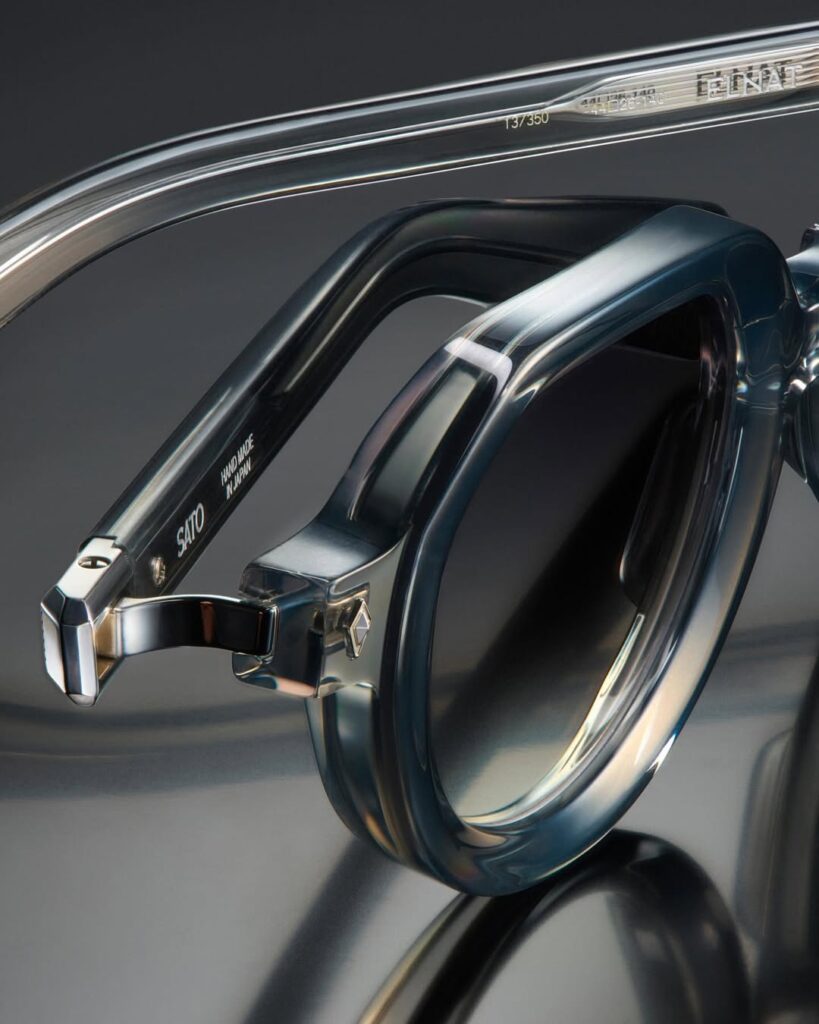
Its design codes pull heavily from 1990s nostalgia, the perspective of a generation raised on that decade, layered with Japanese precision. The references are clear. The hinge construction in its acetate collection echoes the engineering seen at 999.9, while elements of its titanium line recall structural solutions explored by Eque.M.
These are not coincidences. They are signals.
Industry relationships and likely proximity to Japanese manufacturing culture inform a product that feels familiar, but elevated. For Sato, originality is less important than legitimacy.
In many ways, the latest campaign recalls the visual language of major fashion houses like Dolce & Gabbana at the turn of the late 1990s and early 2000s. It feels like a direct translation of the founders’ formative years, childhood and adolescence reinterpreted for a digital era that increasingly craves analog nostalgia. The imagery leans into period-specific cues: a Porsche from that time, a Motorola Razer phone, and the unmistakable “college school” wardrobe of the era. The result is less a campaign than a time shift a carefully constructed throwback reframed for today’s audience.

Opticians, first and foremost, need to rethink how they evaluate brands. Before selecting one, they should be looking at the website, social media presence, campaigns, catalogs, and packaging. For a younger audience, status often outweighs product alone. This shift in fashion was already visible in brands like Supreme, Off-White, Palm Angels, and Rhude, which over the past decade have reshaped high-end fashion by integrating streetwear into the luxury space.
If opticians want to attract younger customers, they need to align with brands that understand this balance, where 50 percent is social media. When a young client walks into a store, the first touchpoint should reflect that world: showing them the website, the Instagram presence, the overall visual identity and vibe.

Selling Status, Not Story
Where Sato distinguishes itself is not in product, but in positioning.
The brand operates with a deliberate opacity, echoing the playbook of Chrome Hearts: minimal visibility, controlled distribution, and a refusal to dilute perception through overexposure. It avoids traditional trade fairs, opting instead for private presentations in hotels and curated showroom environments, an intentional separation from what founders perceive as mass-market noise.
This is not just branding. It’s filtration.
Packaging reinforces the message. At price points starting around $1,400, the unboxing experience is not an afterthought but an expectation, executed with the kind of polish that aligns with its luxury claim.
Playing It Safe — Strategically
There is little risk in Sato’s approach. That is precisely the point.
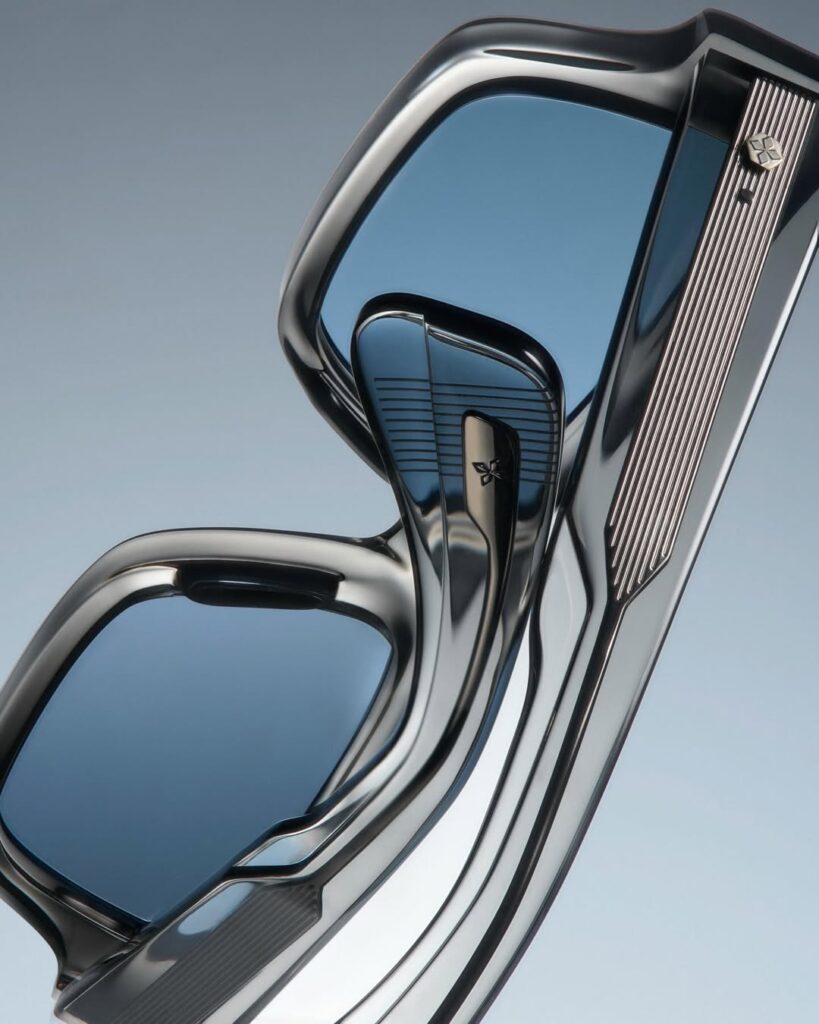
Rather than building a radical design DNA or pushing into conceptual territory, the brand operates within proven parameters: high-end pricing, strong perceived quality, and a carefully constructed aesthetic that resonates immediately with retailers and consumers alike.
It is a “safe” strategy, but in today’s eyewear market, safe sells.
Critics might argue that, in titanium, the bridge with nose pads soldered on top is already distinctive enough to make the frames immediately recognizable. In contrast, the acetate line feels like a broader exploratio, one that, over time, will likely evolve into a more defined and proprietary design DNA.
The Next Chapter
Whether Sato can evolve beyond this phase remains the central question.
For now, it is benefiting from timing: a fresh entrant in a market hungry for newness, yet unwilling to compromise on margin or status. The brand understands the industry it operates in — and more importantly, the psychology behind it.
Sato doesn’t need to be first.
It needs to be desirable.
And, for now, that seems to be enough.



 English
  French
  Italian
  Spanish
  Portuguese
  German
  Korean
  Japanese