


For an industry built on desire, aspiration, and constant novelty, the mood inside eyewear has shifted from excitement to hesitation.
While brands, buyers, and retailers continue projecting confidence, the reality underneath the polished launches and curated campaigns tells a different story: global fashion sales particularly across independent luxury categories like eyewear have softened dramatically in the last quarter. Across multiple markets, sell-through has slowed by an estimated 25 to 30 percent. Launch calendars are being delayed. Full collection debuts are increasingly replaced by safer releases: new lens colors, refreshed acetates, slight material updates.
The innovation machine hasn’t stopped but it has become noticeably more cautious.
And the reason is not as simple as “consumers have less money.”
The deeper issue is fear.
Consumers are holding cash tighter. Retailers are protecting liquidity. Boutique owners sitting on existing inventory are asking the same practical question: why buy new stock before old stock moves?
Across the wholesale ecosystem, planning has replaced confidence.
Everyone is watching. Everyone is waiting. Very few are certain where the market is heading next.
The Weak Dollar Is Reshaping the American Optical Market
Currency pressure is adding another layer of instability particularly in the United States.
A weaker US dollar has become an under-discussed force affecting luxury eyewear economics, especially for American retailers dependent on imported frames, Japanese production, European manufacturing, and globally sourced materials.
When the dollar softens, imported luxury goods become harder to absorb profitably.
Margins tighten. Retail prices climb further. Buying becomes more cautious.
For independent stores already managing slower sell-through, elevated inventory costs create even greater hesitation around opening fresh orders.
The long-term consequence could fundamentally reshape the American optical landscape.
If capital becomes more expensive while margins compress, the market may increasingly favor large retail groups with easier access to investment funding, stronger banking relationships, and better purchasing leverage.
That creates a difficult outlook for independents.
The risk is not simply fewer stores. The risk is fewer truly independent points of view.
Why Independent Opticians Are Struggling to Evolve
Part of this pressure is external. Part of it is internal.
Many independent opticians are still operating with business models built for a customer who no longer exists.
Retail strategies designed twenty or thirty years ago are being repeated in a market shaped by digital discovery, cultural identity, emotional shopping, and experience-led loyalty.
Today’s customer expects more than inventory.
They want curation. Discovery. Exclusivity. Narrative. A reason to visit one store instead of another.
Yet many optical retailers remain hesitant to evolve.
Rather than embracing change, many stay inside familiar buying habits
The Industry’s Fear of New Brands
That hesitation becomes especially visible in assortment strategy.
Instead of seeking fresh perspectives, many opticians continue buying the same brands carried by neighboring stores.
The result is predictable retail.
When every boutique offers nearly identical product mixes, stores lose distinction. Customers lose urgency to visit. Destination value disappears.
The stronger strategy is exclusivity.
Retailers should be searching for brands that offer something unavailable elsewhere in their city products with identity, scarcity, and clear differentiation.
In the current market, uniqueness is not a luxury. It is a competitive necessity.
Why Brands Need to Rethink Wholesale Distribution
Brands also carry responsibility here.
The traditional wholesale mindset opening as many accounts as possible looks increasingly outdated.
Distribution without discipline weakens desirability.
A smarter model may be selective exclusivity: One city. One exceptional partner. Perhaps two or three at most in larger markets.
Then expand into more cities instead.
That approach creates accessibility while preserving distinction.
More importantly, it gives each retail partner a real opportunity to sell volume.
A store committed to moving meaningful quantities from one exclusive brand relationship often performs better than a market flooded with fifty accounts carrying identical product.
Over-distribution has helped create today’s sameness problem.
When every store stocks the same frames, consumers have fewer reasons to enter any of them.
For the independent eyewear industry to remain sustainable, one of the most important shifts must come from both opticians and brands moving away from outdated distribution models.
The 25 to 30 percent margin often lost through intermediaries could be preserved through a stronger direct relationship between brand and retailer. That margin saved creates a healthier business structure for both boutiques and brands, allowing for fairer pricing, stronger long-term partnerships, and a more stable foundation for growth. If retained within the brand-to-store relationship, it can fuel real evolution and progress across the category.
Independent opticians need to build greater trust in working directly with brands, without relying on middle layers.
Opticians should understand that commercial regulations already protect their right to return frames within 30 days in many markets. Most retailers already know the established brands well; they do not need intermediaries to introduce familiar products. What they truly need is the ability to build long-term, exclusive relationships directly with the brand itself not with the sales agent.
The brand has the responsibility to guide the optician with a curated buying selection and explain why certain frames are essential for building a healthy and sustainable partnership.
Luxury Eyewear Is Facing a Confidence Crisis, Not Just a Sales Crisis
Inside the industry, agents and distributors the intermediaries between brands and stores are more anxious than they have been in years.
Geopolitical instability, rising operating costs, energy concerns, and broader economic uncertainty have created a market where visibility is low and forecasting feels increasingly unreliable.
Brands are responding the only way they know how: fighting harder for attention.
More digital storytelling. More aggressive online campaigns. More direct communication. More attempts to manufacture urgency.
But attention is no longer translating into automatic purchasing behavior.
Because today’s customer is not only evaluating style. They are evaluating risk.
Quiet Luxury vs. Fashion Resistance
Some believe the next direction for eyewear lies in minimalism and quiet luxury, mirroring the broader fashion movement toward restraint, permanence, and subtle status.
The influence is visible everywhere.
Cinematography, television, and nostalgia-driven styling continue fueling desire for refined understatement. Shows romanticizing the grainy elegance of the 1990s where simplicity carried emotional weight have helped reintroduce a visual appetite for intellectual minimalism.
But luxury fashion’s biggest houses are not surrendering easily.
Particularly in menswear, there remains strong resistance against disappearing into understatement. Maximal craft, visible design language, and bold identity still matter.
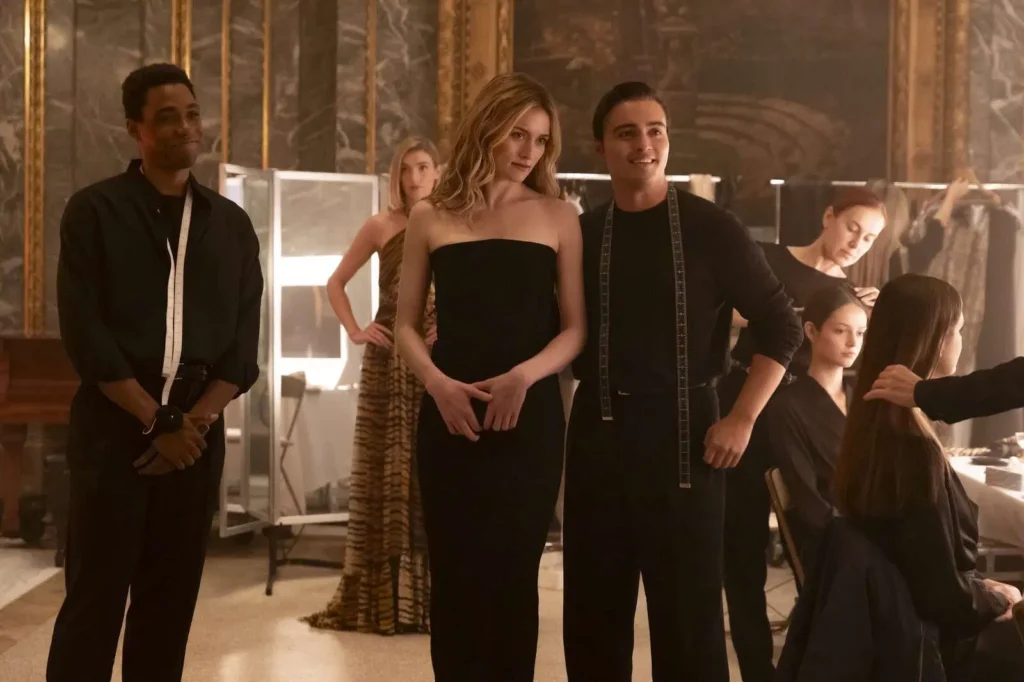
This minimalist direction is being strongly reinforced by recent cultural output most notably the 2026 Love Story series, which has quickly become a visual reference point across fashion. Through its carefully constructed cinematography, styling, and character wardrobes, the series channels a distinctly 1990s aesthetic: clean lines, muted palettes, and an understated elegance that aligns closely with the principles of quiet luxury.
Rather than overt branding or statement pieces, the focus is on restraint, texture, and subtle sophistication elements that resonate deeply with today’s consumer seeking authenticity over excess. The influence of the series is already visible across both fashion and eyewear, where brands are increasingly revisiting archival shapes and refining them through a contemporary, minimalist lens.
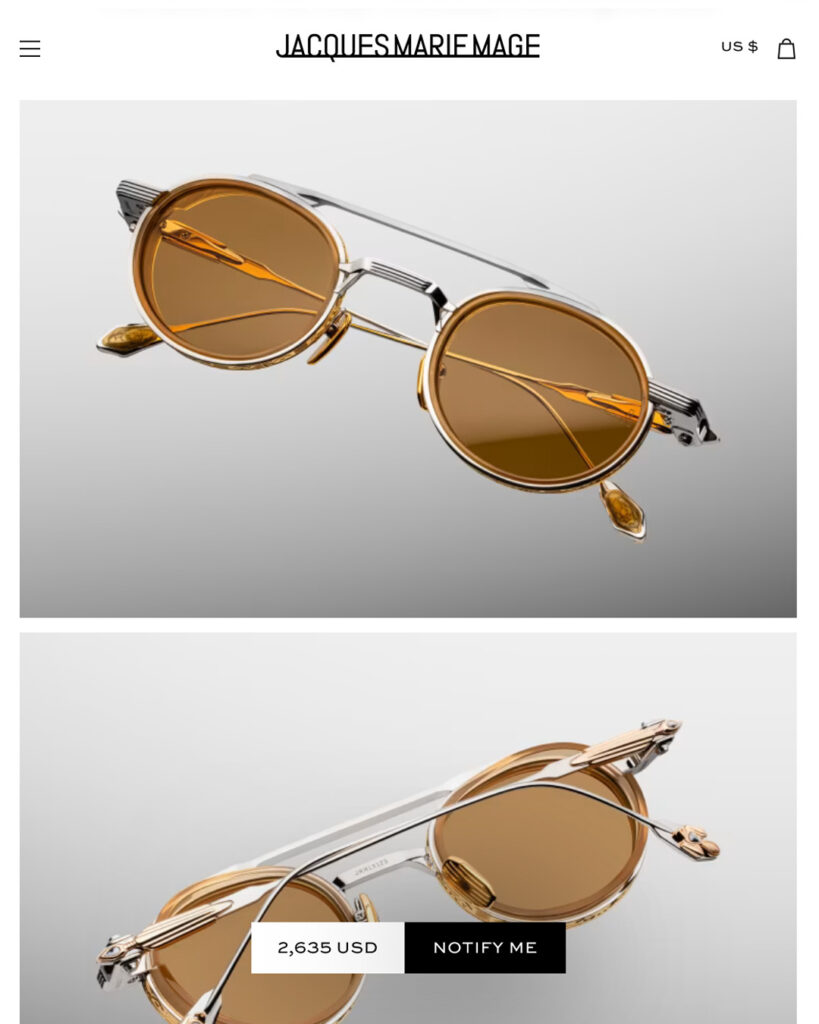
The Price Problem Nobody in Eyewear Wants to Address
One of the industry’s most urgent tensions is pricing.
Luxury eyewear prices have climbed aggressively over the last decade but not always in proportion to product value.
Inflation explains part of the story. It does not explain all of it.
If we look back roughly ten years, frames from Jacques Marie Mage, could retail around $350.
Today, pricing across comparable luxury segments often pushes well beyond $1000.
Retailers themselves are beginning to question the ceiling.
Multiple boutique owners now openly describe these price points as increasingly difficult to justify regardless of premium packaging, exclusivity narratives, or collectible positioning.
Meanwhile, some stores are filling shelves with lower-quality frames lacking design DNA entirely, simply because they need products that can still hit commercially viable price bands.
The contrast is becoming sharper:
True craftsmanship is becoming more expensive. Mediocre product is being sold at luxury-adjacent pricing. Consumers are noticing both.
When Revenue Growth Hides Unit Decline
On paper, many businesses still look healthy.
Revenue figures can appear stable even positive.
But that topline view often masks a more uncomfortable truth.
Growth is increasingly being maintained not because more frames are selling, but because each frame costs more.
Unit volume is declining. Average selling price is rising.
Price inflation is compensating for slower movement.
For now.
The bigger question is how long consumers will continue accepting that equation before exploring alternatives particularly direct-to-consumer models offering stronger perceived value.
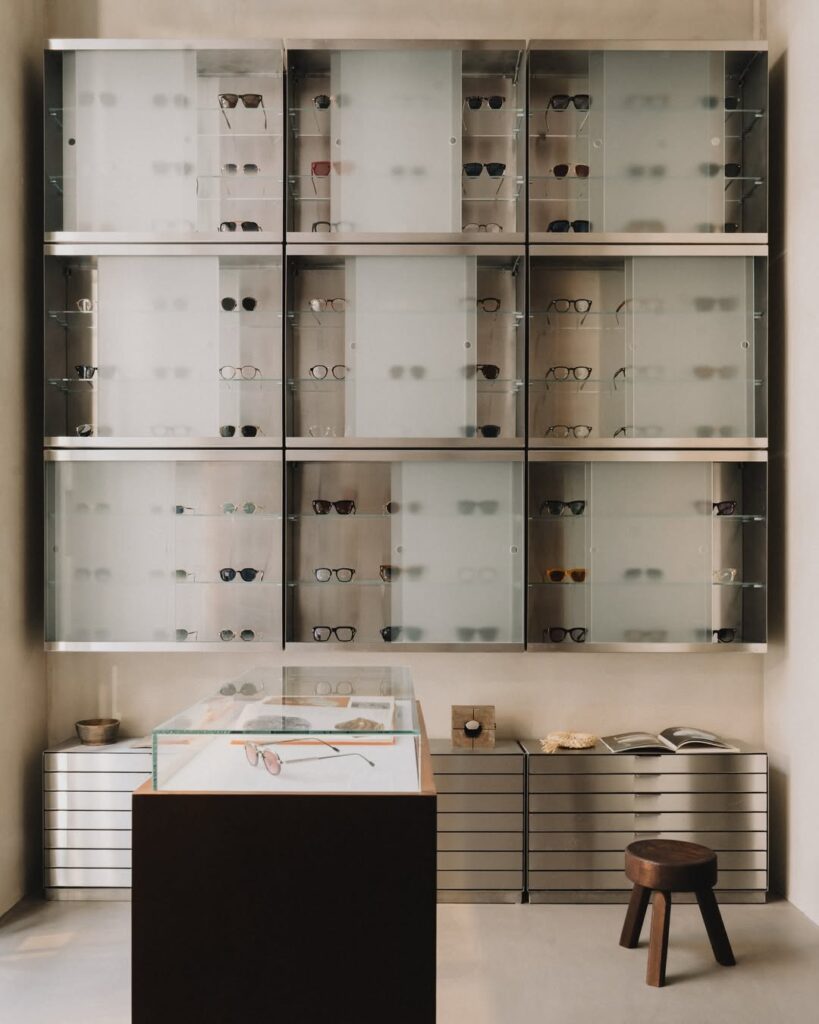
The Boutique Survival Divide
Another structural shift is becoming impossible to ignore.
Stores that failed to evolve beyond transactional retail are struggling the most.
Boutiques that never became destinations spaces built around curation, expertise, community, and memorable experience are finding it harder to justify premium pricing in a cautious market.
In luxury today, product alone is rarely enough.
The environment around the product matters just as much.
Can Eyewear Become Collectible Like Wine?
A fascinating new narrative is quietly emerging inside high-end optical.
What if eyewear inventory should not be treated as dead stock at all?
What if rare frames, preserved in perfect condition, could appreciate like collectible wine, watches, or archival fashion?
The industry increasingly wants consumers to see exceptional eyewear not merely as accessory purchases, but as collectible assets.
Scarcity. Preservation. Future value.
It is an ambitious repositioning.
Whether customers embrace eyewear as a true collectible category at scale remains uncertain.
Particularly because collectible markets depend on trust, provenance, and long-term cultural validation.
The Jacques Marie Mage Reserve Question
That is why industry attention is turning toward what Jacques Marie Mage, may be building through its Reserve project.
Information remains limited.
But the concept appears connected to archival preservation, rarity, and controlled access potentially pushing eyewear deeper into collectible territory.
If executed well, it could reshape how luxury optical thinks about value retention.
If not, it risks becoming another exclusivity story in a market already fatigued by premium pricing.
The Hard Truth
Fashion and eyewear may be experiencing their sharpest slowdown in a decade.
Fuel costs are likely to pressure discretionary spending even further next quarter.
Retailers are cautious. Consumers are selective. Brands are louder than ever.
And yet almost nobody is openly discussing the contraction.
Because on spreadsheets, the numbers can still look deceptively strong.
But underneath pricing increases, delayed launches, and slower sell-through sits a market asking a far more important question:
How much longer will customers keep paying more for less innovation?
That answer may define the next era of luxury eyewear.

 English
  French
  Italian
  Spanish
  Portuguese
  German
  Korean
  Japanese