



In a luxury industry built on scale, licensing, and global distribution, Chrome Hearts has spent decades doing the opposite and winning. The Los Angeles house, founded in 1988 by Richard Stark, evolved from a subcultural leather-and-silver label into one of fashion’s most tightly controlled luxury ecosystems, defined by private ownership, in-house production, and a distribution model that treats availability as a strategic decision rather than a sales target.
Its eyewear story is a case study in how a fashion brand can become category-defining not by “entering” the optical market, but by bending the rules of it.
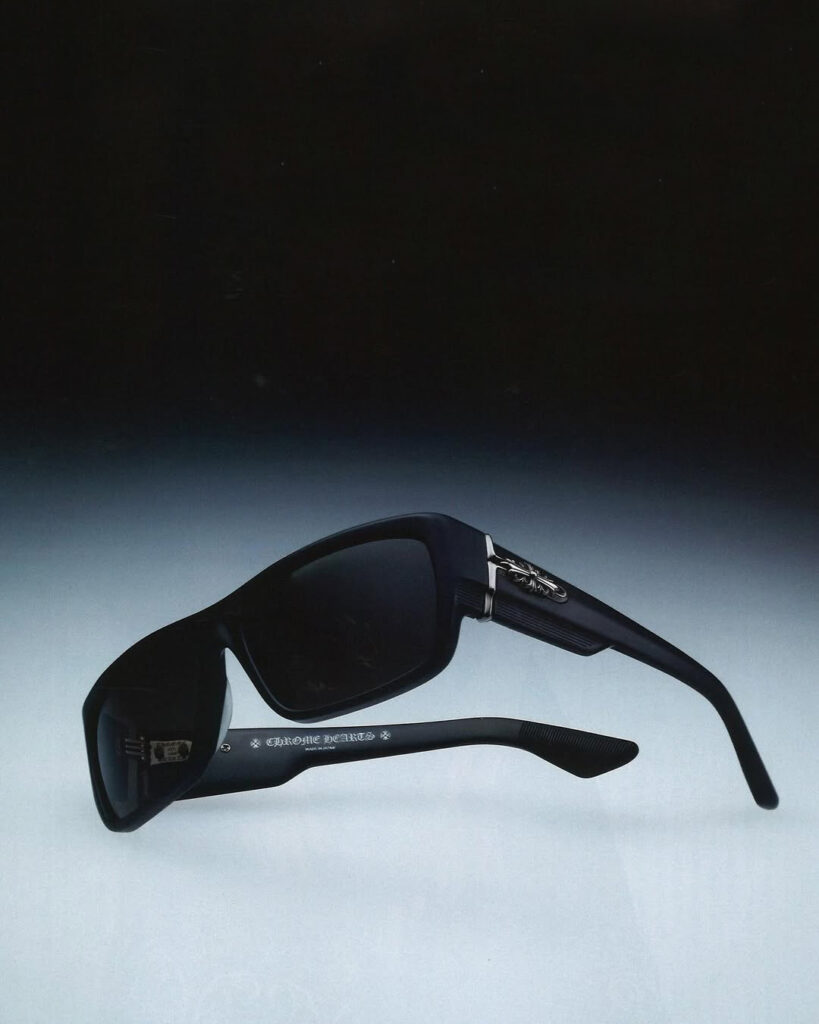
Entering eyewear in 2002—on Chrome Hearts’ terms
Chrome Hearts’ first eyewear collection launched in 2002, a move that made sense aesthetically metal hardware, gothic motifs, and craftsmanship were already embedded in the brand’s DNA.
But what looked like a category extension was, in practice, a brand strategy: eyewear offered a daily-wear object with high signaling value, relatively accessible versus jewelry, and perfect surface area for recognizable codes. The frames became “merchandise” in the original sense: wearable identity.
Selective distribution as brand architecture, not channel strategy
Chrome Hearts’ power in eyewear is inseparable from how hard it is to buy. The brand is known for selling primarily through its own retail network and only a small number of tightly chosen partners an approach that keeps the product inside an environment the company can control, from merchandising to clienteling.
That scarcity is not accidental. It creates:
- Demand that outpaces supply (and therefore protects pricing)
- A sense of initiation (you “get access” rather than “place an order”)
- A retail experience that reinforces mythology (store design, service rituals, and storytelling)
For eyewear specifically where so much of the market is built on wholesale volume Chrome Hearts treats distribution like a luxury material: limited, curated, and expensive to access.
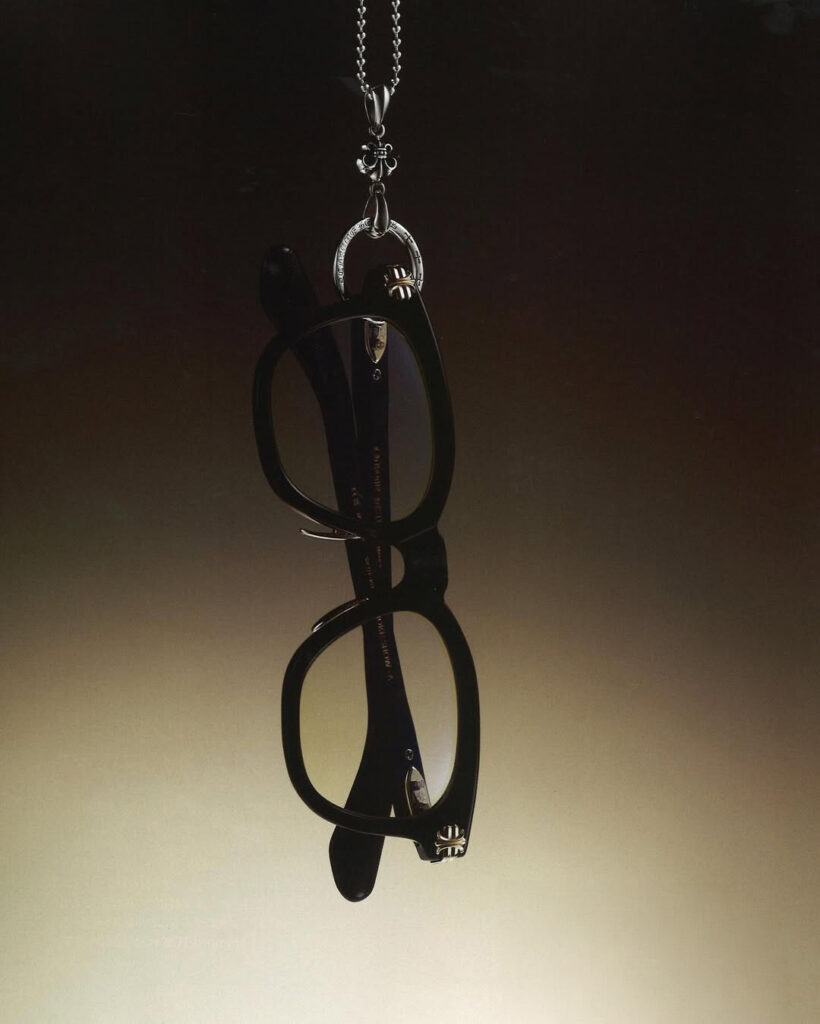
Independent Agents, Reversed Power, and the Distribution Paradox
Chrome Hearts does rely on independent agents in certain markets. But the way it uses them is fundamentally different from the standard model and it exposes one of the most distorted dynamics in today’s eyewear industry.
In theory, agents exist to facilitate access: they introduce collections, manage relationships with opticians, and support logistics. In practice, however, many independent eyewear brands have fallen into a modern paradox: the agent has become the decision-maker.
For emerging labels, the route to market is often controlled not by the brand itself, but by the intermediary. Agents despite having invested no capital into product development, manufacturing, or brand-building frequently dictate what a brand should design, what it should sell, and even what identity it should adopt in order to fit the preferences of optical retail.
The result is an inverted system: the agent becomes a gatekeeper, not a representative. And free market dynamics are quietly replaced by informal control.
Chrome Hearts is one of the few brands that has managed to flip this structure entirely.
Because the company built demand directly at the consumer level through cultural relevance, scarcity, and an unmistakable product language it entered the distribution conversation from a position of strength. Chrome Hearts does not depend on agents to create desire; it creates desire first, and distribution follows.
That shift changes everything.
Limited editions and small runs: turning production constraints into desire
Chrome Hearts’ broader business is built on small production runs, a handcrafted ethos, and a refusal to chase mass demand. That mindset translates cleanly to eyewear: limited quantities, hard-to-repeat models, and frequent variations that keep collectors engaged.
The effect is familiar in streetwear but rarer in optical: the frame becomes less a seasonal commodity and more a “drop,” even when it’s sold through traditional opticians.

The anti-licensing play: owning the product, owning the category
Most fashion brands become “eyewear brands” through licensing handing design direction and production to a specialist group in exchange for royalties. The model is mainstream because it’s efficient: the licensee manufactures, distributes, and scales globally. Deals like Prada’s long-running eyewear licensing approach show how central this model remains to the industry.
Chrome Hearts took a different path: keep control, even if it’s slower.
A pivotal moment came in 2011, when Chrome Hearts acquired Optical Shop International (OSI), described as its decade-long eyewear licensee bringing the category closer to the brand’s direct control. Another industry report noted OSI had held the license to distribute Chrome Hearts eyewear starting in 2001 and expanded distribution widely exactly the kind of growth Chrome Hearts later moved to internalize and govern more tightly.
In other words: where many brands outsource eyewear to become bigger, Chrome Hearts moved to own the machinery so it could stay smaller selectively.

Why eyewear became the brand’s most visible badge
Eyewear is unusually powerful for brand building because it sits at eye level literally and travels across contexts (airports, restaurants, backstage, front row, daily life). For Chrome Hearts, the product works because it compresses the house’s entire language into one object: weight, metalwork, darkness, craft, and attitude.
Add the brand’s celebrity gravity and refusal of conventional marketing playbooks no mass e-commerce, limited availability, and an aura of insider culture and eyewear becomes a near-perfect carrier for cult status.

Conclusion: What fashion brands can learn from Chrome Hearts in eyewear
Chrome Hearts didn’t become a major name in eyewear by competing on shelf space. It did it by competing on control:
- Treat distribution as a creative decision. The channel is part of the product.
- Use scarcity to protect meaning. Limited supply keeps desirability high and discounting low.
- Own the category if the category carries your identity. Licensing can scale revenue; it can also dilute codes. Chrome Hearts’ move to bring eyewear closer in-house shows how seriously it treats control as brand equity.
- Make the object unmistakable. In eyewear, recognizability is currency and Chrome Hearts’ frames are designed to be read from across a room.
- Use sales agents as ambassadors, not gatekeepers. Chrome Hearts proves that intermediaries should execute a brand’s vision, not define it. By creating demand at the consumer level first, the brand sets the rules of engagement: agents function as extensions of Chrome Hearts’ strategy, not as decision-makers shaping what the brand should become. In luxury eyewear, control does not stop at product and distribution it extends to who represents you, and under whose terms.
The result is a rare feat: a fashion label that didn’t just “enter” eyewear in 2002, but used it to become a category authority proof that in optics, the most important brand is often the one most willing to say “no.”



 English
  French
  Italian
  Spanish
  Portuguese
  German
  Korean
  Japanese
[…] such as Ahlem, Jacques Marie Mage, Rigards, Akoni, Anne et Valentin and Chrome Hearts consistently feature among our top-performing […]