


When Rosario Toscano founded AKN Group, he wasn’t simply launching another player into an already crowded eyewear market. He was attempting to redefine the category altogether. “We began with a clear vision: to evolve the way people experience eyewear,” he says. That vision has since expanded into a multi-brand platform Akoni, Götti Switzerland, and Eyetech designed to push craftsmanship, design culture, and technical performance into new territory.
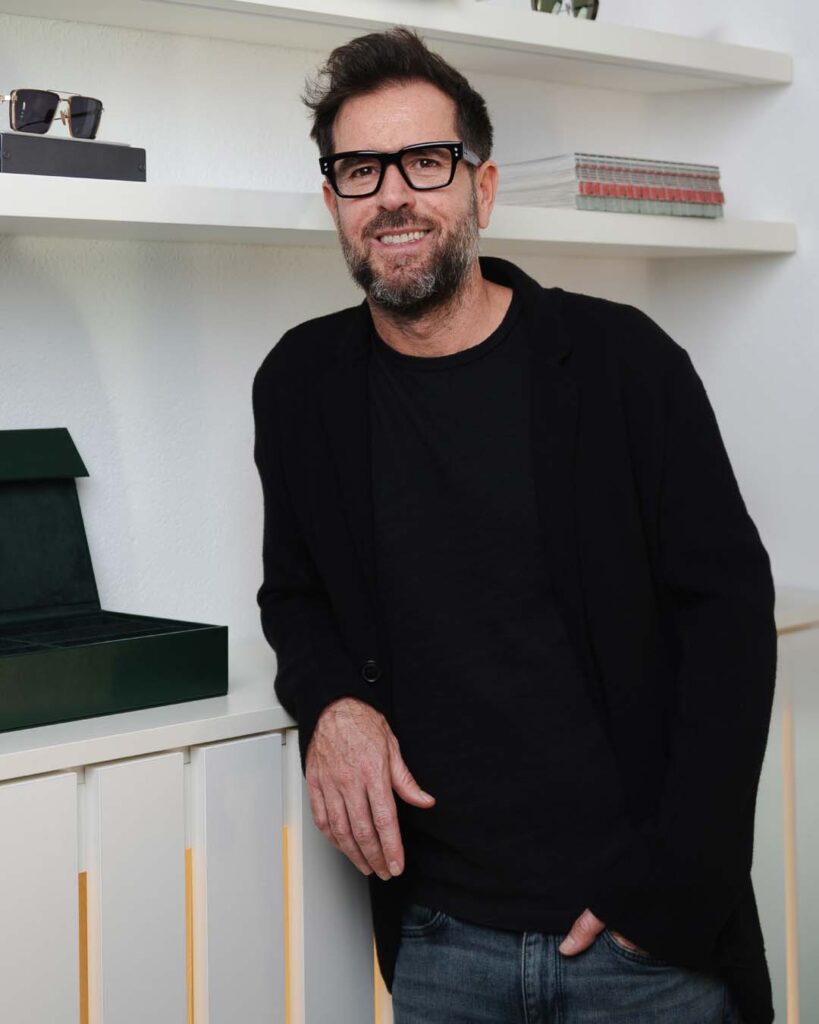
A Foundation Built on Craft—From Balmain to Akoni
AKN Group’s story begins with its early collaboration with Balmain, where Toscano and his team explored the possibilities of couture-inspired eyewear. “It allowed us to work at the intersection of fashion, design, and craftsmanship at the highest level,” he recalls. Akoni was then created as “a manifesto of this philosophy,” a brand intended to elevate eyewear into an object of belonging and permanence rather than seasonal accessory.
Subsequent collaborations with Valentino refined the group’s design intelligence, while the acquisition of Götti Switzerland broadened its technical reach. The addition of Eyetech, Toscano notes, addresses a fast-emerging need: “The lens segment is becoming increasingly crucial in eyewear usage every year.”
Götti, Eyetech, and the Rise of Quiet Luxury
The acquisition of Götti Switzerland is one of AKN Group’s most strategic moves to date. “Götti’s expertise enhances our knowledge and informs our approach to Akoni,” Toscano says. Both brands share a philosophy of precision and understatement—an alignment perfectly timed for the growing “quiet luxury” movement.
“Discerning customers today value craftsmanship, performance, and timeless design over overt branding,” he notes. The integration of Götti’s production mastery further positions the group to lead this shift.

The Power of Independence
In a landscape dominated by licensing giants, Akoni’s independence is a rare stance and a defining one. “Akoni today is fully independent, with complete control over its creative direction, design, and brand vision,” Toscano says. Every frame is conceived internally. There are no external creative authorities, no licensing structures, no brand compromises.
While future special projects may include “select visionaries,” Toscano insists the brand’s core will remain intact. “Everything will always be aligned with Akoni’s vision. That’s how we ensure the brand remains a consistent expression of design, craftsmanship, and identity.”

A Global Creative Team with an Architectural Vision
Creative direction at Akoni is not centralized under a single celebrity designer. Instead, it is led by a globally distributed team working across Switzerland, Japan, California, and Dubai. “They are some of the most renowned talents in the eyewear industry,” says Toscano. Their combined expertise yields an aesthetic he describes as “precise, architectural,” with engineering standards that push performance boundaries. The result? Frames that are immediately recognizable, not through loud logos but through proportion, detailing, and feel.
A Collector Mindset—Not a Luxury Consumer
Akoni’s customer isn’t defined by traditional luxury cues; they are driven by discernment. “They are savvy, deeply aware of quality and comfort,” Toscano explains. These buyers are collectors—individuals who appreciate the subtle luxury of a hinge, the weight of titanium, the tactile integrity of Japanese acetate. “They expect to be surprised,” he adds. “And they seek authenticity that many so-called ‘luxury’ brands lack today.”

Japan as a Strategic Anchor of Excellence
Production is a cornerstone of Akoni’s positioning. Every collection is manufactured in Japan using advanced local materials and specialized machining techniques. “The ‘Made in Japan’ label represents the pinnacle of craftsmanship and precision,” Toscano states. This strategy naturally limits scale: many suppliers and technologies are rare, and their capacity cannot be expanded at the pace of global demand.
Yet scarcity is not a drawback. “It reinforces our brand positioning,” Toscano says. Each limited run becomes a mark of integrity rather than a marketing tactic.
A Market Entering Its ‘Specialty Era’
Toscano sees luxury eyewear on the cusp of a structural shift. “Consumers will increasingly seek eyewear that goes beyond aesthetics exceptional fit, performance, and design that reflects identity.” The next decade, he predicts, will reward brands that prioritize depth over decoration.
Innovation, however, must be anchored in authenticity. “The challenge will be avoiding superficial trends while raising standards in craftsmanship,” he says. For Akoni, this shift represents a significant opportunity: “to lead the specialty segment with frames that are collectible, meticulously designed, and emotionally resonant.”
Distribution as a Fine-Tuned Strategy
Akoni is currently available in nearly 1,000 retail doors worldwide—a number that reflects careful curation, not mass expansion. “Growth must be measured,” Toscano explains. “Many of the Japanese materials and techniques we rely on are rare.”
But retail is more than a commercial channel; it’s a cultural one. “Opticians are our brand ambassadors,” he emphasizes. “They are the primary believers in this rare and extraordinary project.” By investing in education and narrative-building, Akoni ensures that the retail experience mirrors the brand’s high-touch philosophy.
Managing Scarcity Without Compromising Vision
The most persistent challenge for Akoni today is maintaining equilibrium between demand and supply. “Many of our materials are limited, which can create tension with retailers eager for new collections,” Toscano says. The solution lies in meticulous planning and transparency. “We align expectations and focus on storytelling. Scarcity should be understood as a mark of authenticity, not a constraint.”
Guidance for Independent Boutiques
As optical retail navigates shifting consumer habits and emerging technologies, Toscano’s advice is clear: “Combine a refined environment with dynamic engagement. Carry unique, high-performing brands like Akoni.” He encourages stores to curate atmospheres that feel intentional and immersive while integrating elements of entertainment and novelty. “It’s about maintaining relevance through quality and surprise.”

No Rush Toward Consolidation
Despite industry speculation about potential acquisitions or IPO activity, Toscano is unequivocal: “Preserving our independence allows us to innovate freely and uphold the distinctive character that defines Akoni.” For now, autonomy is a non-negotiable strategic advantage.
What Comes Next for Akoni
Looking forward, the brand’s roadmap includes new materials, refined performance innovations, and a series of limited special projects some tied to global events such as the Olympics. There is also focused expansion into China, the Middle East, and other high-growth markets. “The goal is to grow while preserving exclusivity, quality, and the Akoni experience,” Toscano says.



 English
  French
  Italian
  Spanish
  Portuguese
  German
  Korean
  Japanese
[…] compared with the creative directions of brands currently shaping the market Sato, Akoni, Paloceras, The Other Glasses, Ahlem, DAIZO feels more conservative. Safer. Less […]
[…] driver. Fashion spoke one language, sport another. With the launch of the Altitude Series, AKONI is attempting to collapse that divide—positioning performance not as a utility feature, but as a […]
[…] the wave of new eyewear brands launched over the past five years from VOA and The Other Glasses to Akoni and Sato, one name has stood apart by challenging the category from an entirely different […]
[…] such as Ahlem, Jacques Marie Mage, Rigards, Akoni, Anne et Valentin and Chrome Hearts consistently feature among our top-performing […]
[…] creative phase. Several former team members went on to establish new ventures, most notably Akoni, which has since emerged as a strong and disruptive force within the high-end eyewear […]
[…] shows do work, but only under very specific conditions. If you’re a brand like Akoni, backed by significant capital, operating multiple brands under one umbrella, and supported by […]